GLP-1 Is a Shape Shock

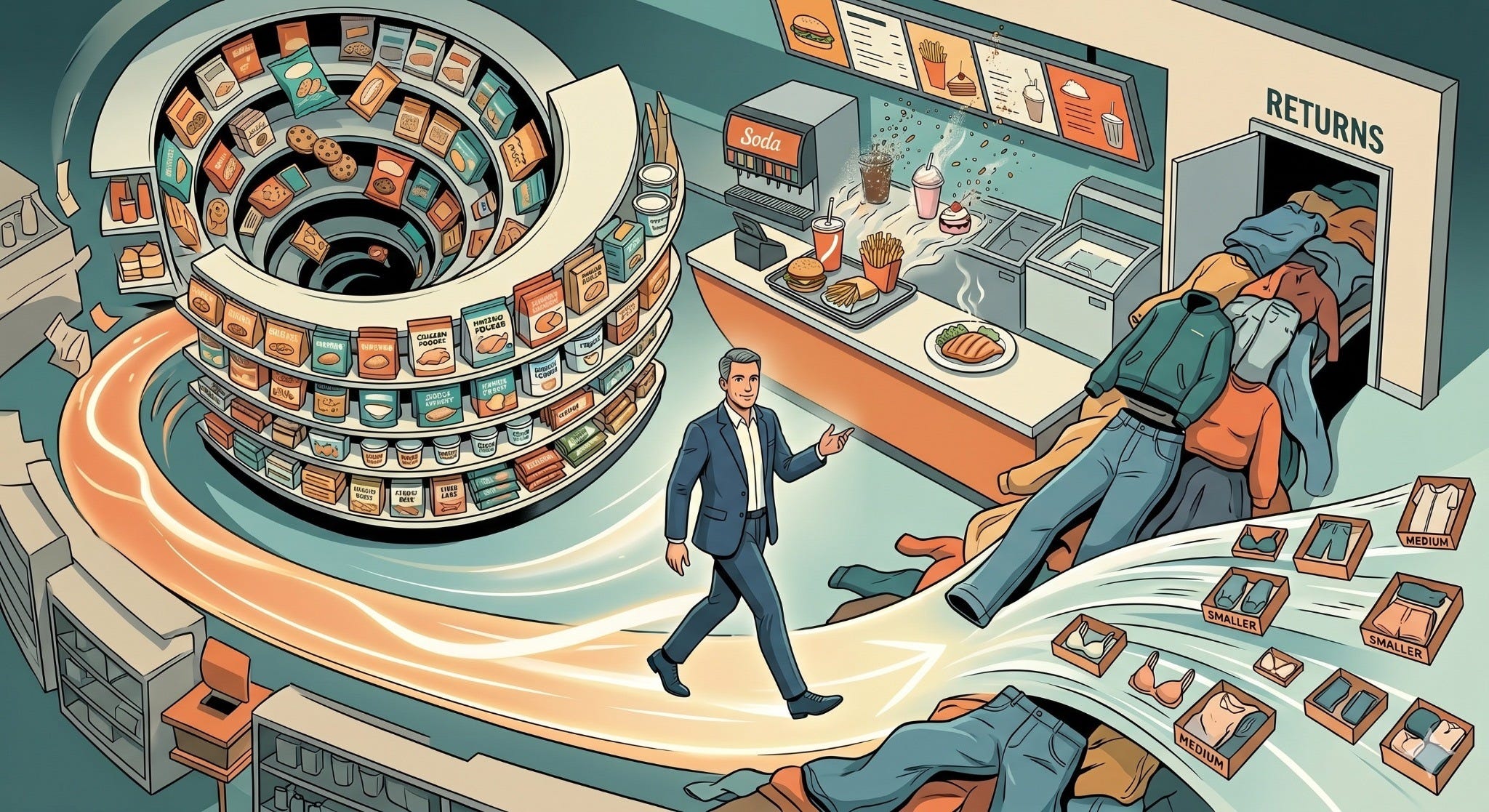
Last year, the share of apparel exchanges in which shoppers traded down to a smaller size hit 14.6 percent, the third straight year it climbed, according to a review by returns-software firm Narvar of 38 retailers.
Retailers think they know exactly what is going on: Customers on GLP-1 drugs are dropping close to a full clothing size a month, and they are mailing back everything that no longer fits.
Impact Analytics, in its Retail Demand Reset report, estimates that for a billion-dollar retailer with a typical 20 percent return rate, a five-to-ten-point jump in returns erases about $20 million of gross margin, and that more than 400 million apparel units a year could be mis-sized by 2027, roughly $5 billion in capital and margin leakage.
The case is being held up as a demand-destruction story: Food companies sell less, restaurants serve less, and the whole category quietly deflates as the country eats fewer calories.
There is real evidence for the level effect: Researchers at Cornell and Numerator, using a panel of roughly 150,000 households, found that within six months of a member starting a GLP-1, a household cuts grocery spending by 5.3 percent. For higher-income households, the cut is more than 8 percent. Spending at fast-food, coffee shops, and other limited-service spots falls by about 8 percent.
Separately, Circana puts the share of US households with a user at nearly 23 percent, up from roughly 11 percent two years earlier, and projects that GLP-1 households will account for 35 percent of all food and beverage units sold by 2030.
The level is the obvious number.
I think the actual interesting story is that demand also changed shape, and the shape is the part nobody is managing.
The average came down a little.
The distribution moved a lot.
A demand shock changes how much a category sells.
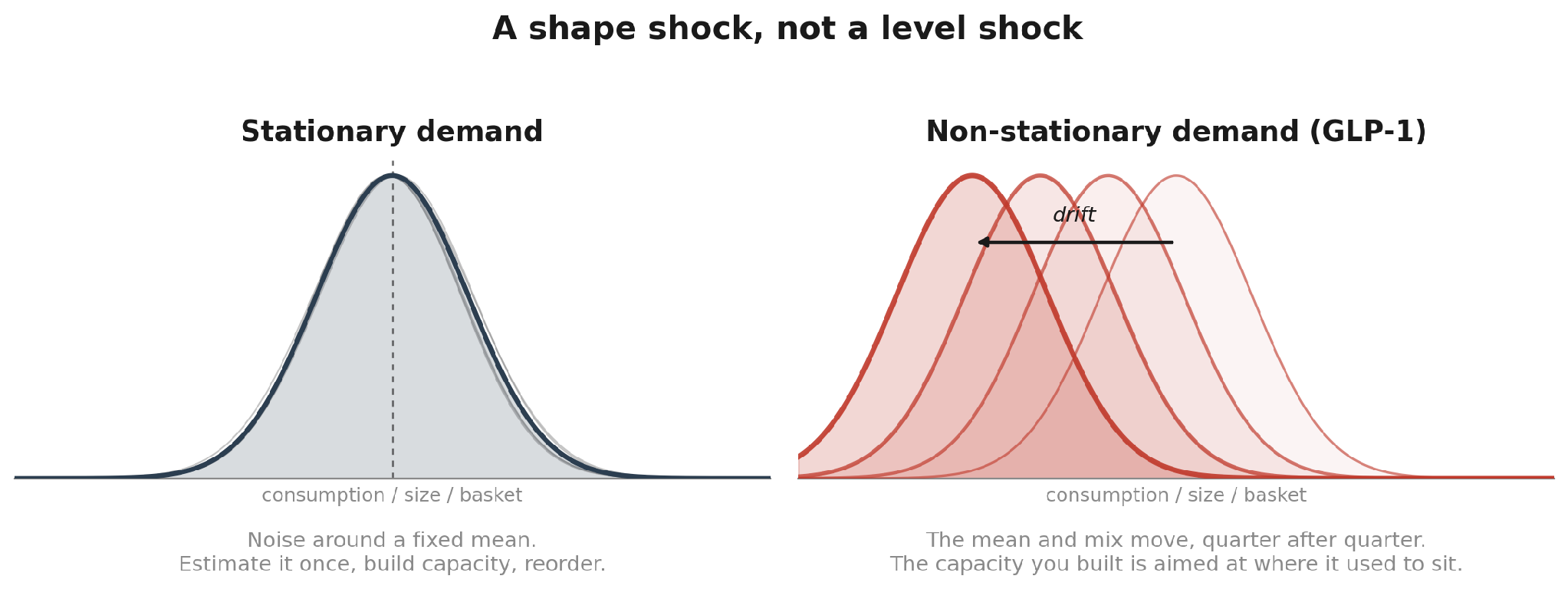
A shape shock changes which items sell, to which customers, and how fast the answer moves, while the headline volume barely budges.
Operations is the one discipline that lives in the shape of demand rather than its average. The category is not necessarily shrinking so much as it is deforming.
Before we dig deeper, it’s important to note that this article is tone deaf by design. We don’t yet know whether taking GLP-1 drugs has long-term implications, but there is no question that, in the short term, the trends I mentioned above are good for society. This article is not concerned with the mental or health care implications of the drug since many others do that (and this is outside my area of expertise). This article deals solely with the downstream operational implications.
The Marginal Item Is the Margin
Let’s start with where the 5.3 percent actually lands, because it does not land evenly.
Savory snacks fell 10.1 percent. Sweet baked goods and cookies fell sharply too, if by a bit less, on the order of 6 to 9 percent.
Staples barely moved.
The headline decline is an average of a category that is being hollowed out in the middle and left mostly intact at the edges. A grocer reading the top line sees a 5 percent problem. A grocer reading the planogram sees a near -10 percent hole punched directly through the center store, which is exactly where the high-margin packaged food sits.
There is a second wrinkle in the grocery data that makes the mix problem worse: The cut is steeper for higher-income households, at more than 8 percent, compared with the 5.3 percent average. The shoppers walking away from the high-margin center-store basket are disproportionately the highest-spending, highest-income ones, the customers a brand can least afford to lose, and the ones most able to pay for the drug in the first place.
In other words, the decline is concentrated in the most profitable products and among the highest-value customers who buy them.
A University of Illinois farmdoc analysis models the country consuming on the order of 20 billion fewer calories a day and spending roughly $1.2 billion a week less on food at plausible adoption rates. That is the level effect, and it is large. It is also still not the part that should worry an operator most.
The same thing happens to a restaurant ticket, and here it happens in a more painful place: GLP-1 users are not eating out much less often.
Maybe the surprising part is that traffic has held up better than the decline in spend would lead you to expect. But what changed is the order: The entree stays, but the second drink, the dessert, and the side go.
To see why that is a margin event, not a revenue event, you have to look at how a quick-service menu is actually priced: A fast-food combo is essentially a cross-subsidy dressed up as a meal. The entree is sold close to cost to pull traffic through the door. The money is made on the attachments.
A fountain soda costs the operator a fraction of a dollar and sells for $2–$4, with a gross margin of around 90%. Fries run about 85 percent. The blended store margin is around 60%, which means the drink and the fries are carrying the protein (a topic for a whole different newsletter).
So the GLP-1 customer orders the one part of the combo that was never making money and declines the two parts that were.
Spirits tell a related story one aisle over. US spirits revenue fell 2.2 percent in 2025 to $36.4 billion, the category’s first decline in decades, with tequila off 4.1 percent and vodka off 3 percent even as low-calorie ready-to-drink cocktails grew.
The drinks industry first used generational and economic explanations, and some of that is clearly right.
But the high-margin, high-calorie, impulse end of the category is exactly what a drug that blunts both appetite and the reward circuit behind impulse buying would switch off first.
Even where the category-level decline is real, it is concentrated at the profitable end.
The Customer Became Non-Stationary
But I think the deeper problem is not which items move. It is that the customer stopped holding still.
Every operating system in retail and food service assumes a stationary demand process: You estimate the mean and the variance of demand once, you build capacity and inventory and a labor schedule against that estimate, and you reorder.
The assumption has always been that the customer next quarter wants roughly what the customer this quarter wanted.
Forecasting, replenishment, planogram facings, fryer capacity, the back-of-house schedule, the reverse-logistics network. All of it is calibrated to a distribution presumed to sit still.
A GLP-1 cohort does not sit still.
It is on a trajectory.
Calorie intake is down about 21 percent; much of the cohort is still early in the dose escalation that drives the effect, body size dropping a size a month at peak, preferences sliding from sugar and volume toward protein and fiber.
The consumption you will see from this customer next quarter is structurally different from what you saw last quarter, and it keeps moving until the dose stabilizes. The system was built to absorb noise around a fixed point. What is getting the drift?
A fair objection is that operations retool all the time. Menus get reset, planograms get reworked every season, the low-carb wave and the plant-based wave came and went, and the shelves absorbed them.
Two things make this one different. The drift is fast, a size a month rather than a slow change in taste, and it runs in one direction for the same biochemical reason across millions of people at once, so it does not wash out across a panel the way idiosyncratic preference noise does.
It should be clear. Consumption will stabilize, which makes this a regime shift with a multi-quarter transient rather than a target that moves forever.
However, the operators who get hurt are the ones who treat the transient as noise and wait it out, then look up to find the regime has already moved.
That is a trapped-capacity problem, and it is the expensive kind. The freezer set aside for the dessert SKU, the fountain lines, the center-store facings, and the reverse-logistics lanes are sized for a stable return rate. None of it resizes at the speed at which the customer is changing. The asset is committed to a distribution that has already moved on.
The drift does not stay on the shelf either. It propagates upstream and amplifies as it goes, in the way every operations student learns that demand signals distort as they travel back through a supply chain.
A 10 percent decline in snack purchases at the register is not a 10 percent impact by the time it reaches the manufacturer, who built a plant, signed multi-year ingredient contracts, and scheduled production against a forecast that was supposed to grow. That is the bullwhip, and it is only half the problem.
The other half is that the decline does not respond to the usual lever.
What makes it hard is that this is not the case of a price-sensitive customer but a biologically less hungry one. So, a trade promotion that could move a stable demand curve along the price axis does nothing to a curve that is shifting for metabolic reasons. Discounting into that gap is the most expensive way to learn that the constraint was never priced, and confusing the two is how a soft year turns into a write-down.
Returns are the cleanest place to watch this happen, because there the drift shows up as a flow rather than a level. For decades, es a return was a noise term. It was a fixed property of the catalog, a function of fit error, and customers ordering two sizes to bracket one. You could forecast it, price it into the margin, and build a reverse-logistics operation around a number that barely moved.
For a GLP-1 customer,r the return is not noise. It is a trend term, a direct function of their metabolic trajectory.
The numbers around that flow are not small. Americans returned close to $850 billion of merchandise in 2025, about 15.8 percent of sales. Industry estimates put the cost of handling a single return at $20 to $30 before you count anything else, and for apparel, the all-in processing cost can reach two-thirds of the item’s price.
As this newsletter has discussed multiple times, the reason it runs that high is that a returned garment rarely makes it back to a full-price shelf. It gets return-shipped, inspected, often steamed or repackaged, then re-listed, and by the time it sells, it is a markdown or a liquidation-pallet item, if it sells at all.
Every touch in this reverse logistics supply chain involves labor, and every week spent in a returns center is a carrying cost for a seasonal good that is losing value by the day. Layer a structural, drug-driven return rate on top of the catalog’s baseline, and you get the figure from the top of this piece. A five- to ten-point jump erases $20 million in margin at a billion-dollar retailer.
In this case, the operator cannot fix it by adopting a stricter returns policy because the customer is not abusing it. They are succeeding at losing weight.
Who Gets Paid by a Moving Customer
Here is the inversion. The same force that taxes one operating model pays another, and the sign depends entirely on whether your unit economics improve or deteriorate when the customer’s size changes.
The demand for wardrobe replacements is enormous, and it is the mirror image of the returns wave. Around 80 percent of GLP-1 users expect to need new clothing as they shrink, and 55 percent have already bought new clothes or shoes because of it. Denim is the top category, and the rate has been accelerating since early 2025. Old wardrobes are getting listed for resale, which is lifting the secondhand plus-size market at the same time.
That resale channel is not a side note, because it competes with primary retail for the same shrinking wallet.
A customer dropping four sizes floods the market with their old large clothes and is herself a prime candidate to buy the next size down secondhand rather than at full price, so the resale platform feeds on both ends of her transition, while the primary retailer watches the replacement demand it was counting on leak to a channel it does not own.
A customer who needs a full new closet every few months is a real catastrophe for a single-purchase retailer that is eating free returns, but also a gift for anyone whose model is built around restyling and repeat fitting.
We may see new business models emerge. A subscription or styling service is paid by motion: The faster the customer changes shape, the more often the relationship transacts.
None of this is free, of course: A styling service eats its own return shipping and carries the same fitting volatility. The difference is that the relationship survives the size change rather than ending in a return and churn. The advantage is retention through the transition, not immunity to its cost.
The sizing data already shows the same split inside a single category. Sales of larger bras, the 42-plus bands and D-plus cups, have slowed, while mid and smaller sizes have picked up.
A denim maker that reads this as a demand decline will cut orders across the board and miss it, but a denim maker that reads it as a distribution sliding toward smaller sizes will re-weight production toward the sizes now growing and gain share while a competitor marks down inventory in the sizes that are shrinking. Same data, opposite read, and only the operator who saw a shifting distribution retools the line in time.
Food may follow the same trend: the cohort projected to drive a third of food and beverage units by 2030 is demand for a different basket, not a hole in it: Higher protein, higher fiber, smaller format, more nutrient density per calorie.
Whoever can re-engineer the center-store assortment and the QSR menu around that basket captures share that the incumbents are bleeding on the legacy mix.
The reformulation economics are not trivial, because protein and fiber cost more per unit than sugar and starch, and a smaller portion at a similar price is a margin trade the operator has to be willing to make.
But the alternative is selling a shrinking customer a basket she is actively trying to avoid. The decline and the opportunity are the same event seen from two ends of the planogram.
So the question that matters is not whether GLP-1 is good or bad for retail. That question has no good answer.
The useful question is operational: Does your model get paid when the customer moves, or does it get taxed?
For decades t, the binding constraint in food retail and food service was filling capacity, moving volume through a fixed asset base.
GLP-1 quietly swapped that constraint for another. The job is no longer to fill the capacity. It is to track a target that will not stop moving for a while.
Obviously, most systems were never built for that, and the ones that were are about to look very smart.
The Operations Reading
Some of my colleagues may not like to acknowledge it, but operations is the management of the second moment.
Marketing asks whether demand exists and how big it is.
Operations asks what shape it has.
A shock to the average is a marketing and finance problem you can model on a spreadsheet.
A shock to the shape is an operations problem you have to physically rebuild for, and GLP-1 is a shock to the shape. The five percent everyone is quoting is the least important part of it.
This is also why operational excellence aimed at the old model offers so little protection: The grocer with the most efficient center-store replenishment or the QSR with the tightest attach-rate discipline is not ready for this.
Each of them built a moat around being excellent at serving a customer who is now changing.
Efficiency against the wrong distribution is not a moat, just sunk investment in a target that moved, and the better you were at optimizing for the old shape, the more committed your capacity is to it.
The advantage in the next few years will go to the operator who notices soonest that the model itself is in motion, and reallocates capacity toward where the distribution is heading rather than where it used to sit.
I really enjoyed this!