
Over the last few weeks, Hyrox became a huge topic of conversation, to the point that the NY Times wrote an article about it with the final sentence being “It shouldn’t take somebody soiling herself on an international stage to wake us up to how ugly sports culture has become”
How ugly sports culture has become.
As a long-time subscriber to the New York Times (I had a subscription the day I moved to New York more than 25 years ago), I can say that being on the other side of the New York Times almost became a point of pride.
I just finished an Ultra Marathon (66.7 miles, 105 km, 12K ft of vertical gain) with a group of other crazy people. The camaraderie among the runners, the help at the aid station, and the devotion to doing hard things were all evidence to the contrary of “how ugly sport culture has become.” Admittedly, I didn’t soil myself. So maybe I don’t get it yet.
With that out of the way, let’s get to the more interesting story about Hyrox.
About a month ago, a consortium of L Catterton, the private equity firm backed by LVMH, Jeffrey Katzenberg’s WndrCo, and Hyrox’s own co-founders bought out Infront Sports & Media’s majority stake in Hyrox at a reported valuation of about $700 million. The founders, Christian Toetzke and Moritz Fürste, are reported to have each received roughly 51%. They sold control of their company in 2022 and have now bought it back with luxury-goods money.
For those who don’t know: Hyrox is a “fitness race” held inside convention centers. You run one kilometer, then pull on a ski machine. You run another kilometer, then push a sled. Eight rounds of this, with rowing, lunges, burpees, and 100 wall balls along the way. The first event, in Hamburg in 2018, drew 650 people. This season, the company expects more than 2 million.
In February 2020, Tough Mudder, the last fitness event that was going to change everything, was sold out of bankruptcy for $700,000 and the assumption of its debts.
Same digits. Three more zeros.
I am a runner, which means I already have a view. A race is a start line, a finish line, and a clock. The format was pretty much determined around 490 BC. If your event needs a sandbag, a DJ, and a branded photo wall to get adults to cover eight kilometers, you have not invented a sport. You have invented a reason to buy the t-shirt. My instinct is that it is a product in search of a sport. The average man in the Hyrox Pro division finishes in about an hour and twenty-two minutes. Roughly half of that is spent doing what I would call jogging between errands.
This article is written by a “runner” (i.e., someone who runs) and a dad. So expect some dad jokes. If you are offended by these or find them annoying (or just not funny), this will be a painful article to read.
Most news stories treat the sale as a verdict on fitness culture. The Hyroxers (I am not sure if this is the proper noun) probably talk about the sold-out tickets. The skeptics say it’s just Tough Mudder with better lighting (and maybe better music).
I have sympathy for the skeptics, but I would argue that we need to look beyond just the race itself when thinking about this $700M, and, in particular, consider the royalty stream from 15,000 gyms that teach it.
Nobody owns the marathon. Two Germans and LVMH’s money own Hyrox.
Before the Hyrox people write in: yes, I know.
My sport sells a six-medal loyalty program sponsored by a pharmaceutical company. It charges about $300 for the right to stand on a bridge in Staten Island for three hours, and it compels you to buy “supershoes” to gain a few seconds that you could have gained just by training more seriously.
Ironman’s owner also owns the Rock ‘n’ Roll series, which puts a band at every mile.
Runners are not purer. We are just worse at capturing the money.
Why Is This Worth $700 Million?
Before we delve into some math, a word on the number: Infront’s announcement confirms the sale of its majority stake and discloses no terms. The $700 million is a reported valuation of the whole company, not cash that changed hands, and the Tough Mudder comparison at the top sets a distressed asset price against a whole-company valuation.
Furthermore, the company is private, so all subsequent numbers are estimates.
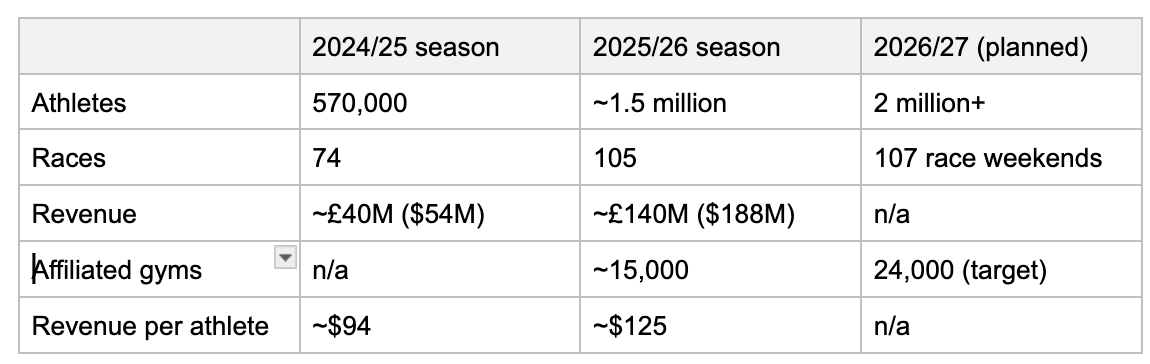
SportsPro puts 2025/26 revenue at about £140 million, or $188 million, up from £40 million the season before. Athletes went from 570,000 to about 1.5 million. Races went from 74 to 105. Another 1.5 million people bought spectator tickets, which means Hyrox has persuaded one paying customer per athlete to stand in an exhibition hall and watch someone do lunges. (My wife and dog just came to crew for me this weekend at the Ultra Marathon, so while they didn’t buy tickets, they had to suffer in a much more significant manner, being with me from 4 am until 10 pm. Again: take the statements above as a point of reference, rather than any value judgment.)
Outside estimates EBITDA margins at around 20 percent, which would put the valuation at about 20 times estimated EBITDA. For those who do not deal with evaluating such deals every day, this type of multiple is appropriate if the firm is about to double its revenues. Bold assumption.
Entries and tickets account for 55 to 65 percent of revenue, and sponsorship from Puma, Red Bull, Amazon, and others accounts for about 15 percent. Merchandise is estimated at $40-$50 million. These are drawn from different sources, so they don’t really reconcile, but the shape is clear enough. Most of the money comes from people paying to enter and watch, and something like $30 a head goes toward a t-shirt.
But the more interesting revenue comes from about 15,000 gyms that pay Hyrox an affiliation fee, reported at around $1,500 a year in the US, to call themselves official training clubs and run Hyrox-branded classes.
Using the US free, 15,000 gyms would imply about $22 million a year. The gyms get first access to 50% of all race tickets, which is a big incentive given the fact that many of these sell out. Hyrox took its scarcest resource, race slots, and turned it into the incentive that makes gyms pay to become its sales force. There is a channel to manage and affiliates to support, but there is very little paid advertising because 15,000 gym owners do the recruiting and pay for the privilege.
You have to love the relationship between the gyms and the race.
The main issue for most gyms is retention, but you are much more likely to stay and train if you have a goal race on a particular date. I think of myself as a fairly self-motivated person. Yet, I know that on a cold day in December (or January) or even a busy day in June, there is no way I am running, unless I have a race, which is why I always have a race on the horizon (or in this Fall, an Ultra marathon, two marathons and one Half marathon, but I digress).
Back to Hyrox. Hyrox classes solve exactly this problem for the gym. A programmed class with a goal date, using equipment already on the floor, lifts retention, and maybe even justifies a premium tier. I know you are probably asking what’s novel about it, and I am not sure, but it’s clear that Tough Mudder never had this. No business with its own P&L woke up every morning needing Tough Mudder to survive. This looks like a franchisor whose franchisees do not know they are franchisees.
But this brings us to the comparison Hyrox executives prefer.
Douglas Gremmen, the chief growth officer, told SportsPro that Hyrox is now “bigger than all of the world marathons combined.”
What?
I went looking for the math, hoping to mock him.
Well… Global marathon finishers peaked at about 1.3 million in 2018 and have run around 1.1 million a year since. He expects 2.5 million Hyrox athletes in calendar 2026, a company projection that counts entries rather than people. Even so, it is plausible that more entries will be sold to push a sled across a carpet this year than there will be marathon finishers anywhere on earth.
I get no joy from tying this.
It is the wrong comparison anyway.
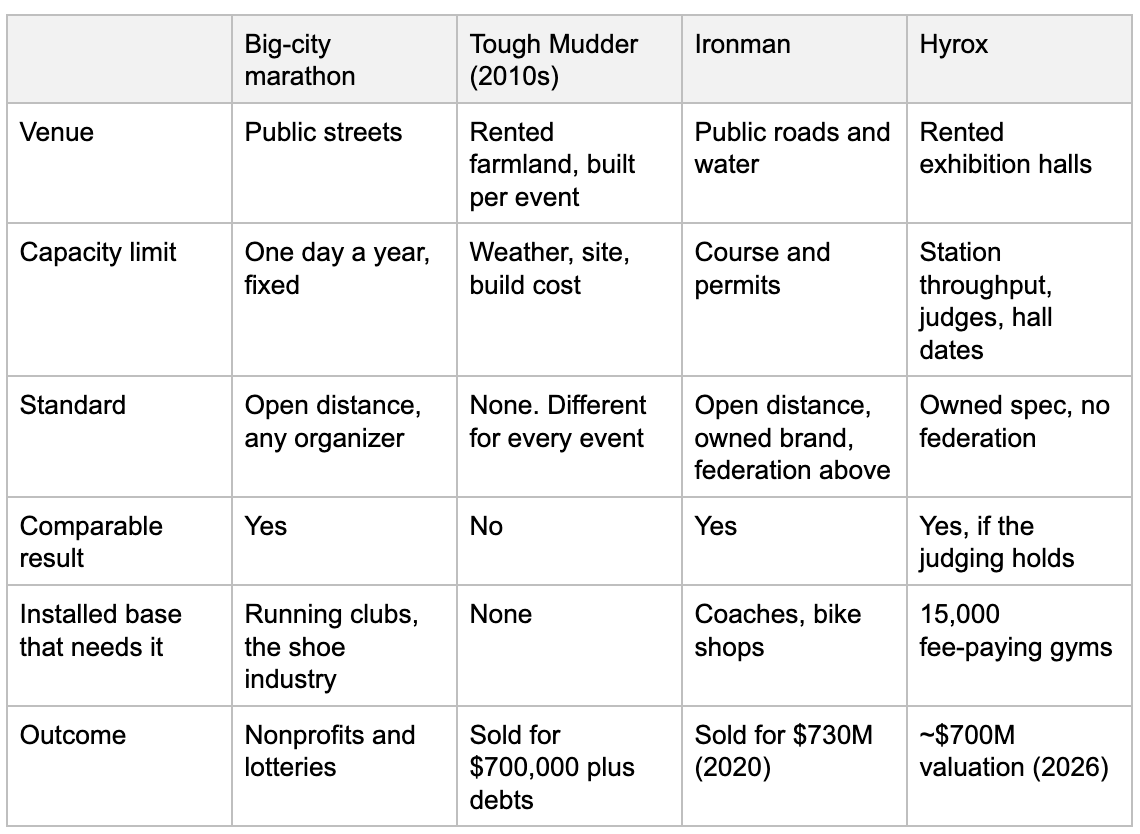
The 26.2-mile distance is open source. Anyone can measure a course, put up a clock, and call it a marathon, which is why New York’s is run by a nonprofit and why there is nothing for a private equity firm to buy.
Ironman is closer, since it owns a brand, but it sits under a federation and competes with other organizers over an identical distance.
Hyrox combines the brand, the race series, and the championship under one owner. Don’t get me wrong. Anyone can copy the workout. It’s the branding and the social status associated with it that are hard to copy.
How Do You Put 50,000 People Through a Convention Center?
Long-time readers of this newsletter know that there is always an operational angle. To be honest, until writing this article, I didn’t think about how good their operations are. (BTW: this is why I am writing these articles. )
Let’s take a big-city marathon like New York or Boston. They need the streets. This access, which may seem trivial given the public nature of these streets and the publicity and tourism these marathons bring to the respective cities, is a significant limitation and a major undertaking.
The street needs to be available one day a year after a negotiation with the police, the transit authority, the sanitation department, and every church on the route. New York had 59,226 finishers last November, the largest marathon ever staged. More than 240,000 people applied for the 2026 race and about 1 percent got in through the draw. The race cannot add a second Sunday. Its capacity is set by geography and politics, and demand has nothing to do with it. It’s well known that Boston needs to decline many applicants who actually qualified, since it doesn’t have permission to add runners.
Long-time readers know the mantra: Tell me what constrains you, and I’ll tell you where your strategy should focus.
Hyrox went indoors, which removes weather, road closures, and permits in one move.
A Hyrox in Chicago in February is supposed to be the same race as one in Singapore in August. Athletes start in waves every few minutes, which turns the hall into a flow line with a fixed loop, eight workstations, and a flow time of 60 to 100 minutes per athlete.
The kit travels in containers from city to city. Fürste has described the founding ambition as “a €200,000 production that looks like a €2,000,000 production,”.
When demand exceeds a weekend, the company adds days. Some events now run as residencies lasting up to 10 days, and the New York event has a capacity of about 52,000 athletes.
That is a New York City Marathon’s worth of people, processed over a week rather than a morning, without closing a bridge.
The advantage is scheduling freedom, not raw daily throughput, and scheduling freedom is what a marathon can never buy. Boston always runs on Patriots ‘ Day. The week after that is in London. Not a lot of negotiation there. Well, not so true: in what is considered unprecedented, London (which was the hardest marathon to get into by Lottery) just announced that it's turning it into a two-day event, hoping to accommodate 100K runners. I don’t know of any major city that would even consider that. Mayor Mamdani is a marathon runner (finishing the NY Marathon around 6 hours, twice), so maybe there is a chance.
Compare that with obstacle racing.
Tough Mudder built a temporary town in a field for every event: scaffolding, mud pits, parking for 10,000 cars on a farm, and dangling electrified wires presented as an athletic test. Every event was a construction project exposed to rain. Revenue reached about $75 million by 2014, and by early 2020, the creditors forcing it into involuntary bankruptcy included building contractors. It had a great brand but an operating model where nothing was reusable, including its customers. Spartan bought the remains and has since launched its own indoor fitness race, which tells you what Spartan thinks of mud.
But the bottleneck is not the building. Inside the hall, the limit is the number of athletes the slow station can “process” per hour, given its lanes and judges. This bottleneck also determines the wave density, which needs to be capped. More simultaneous athletes need more judging capacity, and longer race days need more judge-hours.
The interesting part of Hyrox is that when you wait for a station, the clock is still ticking. No one likes crowding in the marathon, which is why fighting to get a good corral is so important for good runners. But most marathon runners don’t care so much about crowding. In fact, for most social runners, the crowds are part of the story.
Crowing at Hyrox has a real impact on your outcomes. Last year, Hyrox apologized for the queue at the Wall Balls station at London Excel 2025:
“We’re truly sorry that the congestion at the Wall Ball station disrupted your recent race experience. This is not the standard we aim to deliver… Our team has reviewed the issue in detail. On this occasion, the decision to use the wait pen rather than redirect athletes to empty targets was made to maintain consistent judging standards and the overall integrity of the competition. “
There is also a tension the company has to manage. Buyers describe tickets in the UK as “gold dust.” One participant told a reporter she was 6,000th in the online queue, hit a glitch, and found herself 30,000th. With demand like that, a $185 ticket looks deliberately cheap, and I think it is. A 20% price increase on roughly $110 million in ticket revenue would be worth about as much as the entire affiliation line, so whatever the pricing protects is not license fees. It is the funnel: scarce tickets keep gyms enrolled, and gyms keep the funnel full. More race days make priority access less valuable.
They also give more gym members something they can actually enter. Hyrox needs enough scarcity to make affiliation useful, but not so much that training ends at the ticket queue. As of last November, the site that tracks ticket prices noted that American races, the most expensive in the world, often did not sell out.
Which brings us to the question you are probably all asking.
Fad, or the Next CrossFit? Those Are Different Insults
The fad case is familiar.
One outside estimate puts first-timers at 70% of a given field. That could be tourism, or just what doubling every year looks like, since a perfectly retained base surrounded by new arrivals produces the same statistic.
The useful number is how many of last year’s first-timers came back, but nobody outside the company has it, and the fact that they don’t publish it (or even leak it) makes me suspicious.
The copycats have arrived under names like Athx, Metrix, and Deka, right on schedule for year three of a fitness craze. There is a doubles division, where you split the work with a friend, and a relay, where you split it with three. Running has a word for covering a quarter of the distance. The word is spectator.
I still do not think Tough Mudder is the right precedent, because of one design decision. Tough Mudder’s course changed every time, so your result meant nothing,and there was no reason to return. What Hyrox sells is a number. A 1:22 in Dallas can be held against a 1:31 in London the year before. There are age-group rankings, qualifying standards, and a world championship. People train for months in those 15,000 gyms to shave four minutes off their time.
I know this product because I am part of this as well. A (somewhat) standard course, a clock, a personal best, and a lifelong, slightly unhealthy relationship with a number: that is the whole logic of running Marathons again and again, and it has held runners for a century.
A more interesting comparison is CrossFit. CrossFit also owned a standard, taxed an affiliate network, and ran a championship on top of it. Its affiliates peaked at roughly 15,000 in 2018, which is the number Hyrox has now. Then the founder blew up his own brand in 2020, the annual fee went from $3,000 to $4,500, and the affiliate count fell to around 10,000, with the company put up for sale.
Hyrox has two exposures of this kind. The first is that you cannot trademark a sled push. The name is protected, but the exercises are free, so a gym owner can run an identical class on Monday under a different name and keep the $1,500.
The second is that the real asset is the number, the PR. And this number is only as good as the judging. Sled times depend on carpet friction, which varies by venue. Weekend volunteers enforce rep standards.
This brings me to where the article started. As I mentioned above, this month in Beijing, officials allowed an elite athlete who had fallen ill to continue using shared equipment; she won, later withdrew from the results, and the company apologized and wrote a stoppage rule (after the fact). The same company sells the tickets, certifies the result, and decides when the show must stop. But this is exactly what it means for a sport to have an owner.
Final Words
The comparison to marathons and other running events raises an important question about who creates and who captures value in mass-participation sporting events.
Events are expensive, perishable, and easy to copy, so the value accrues to whoever owns the standard.
An open standard, like a Marathon, lets many businesses build around the same sport, which is why the marathon economy of shoes, watches, apps, and thousands of independent races dwarfs any one organizer.
Hyrox is testing how much of that activity a single owner can capture without making affiliation less attractive.
Running gave away its standard 2,500 years ago, which is why my sport is run by volunteers in reflective vests and Hyrox has a cap table.
Congrats on your 66.7 mi with 12K of climbing , your tendons deserve their own recovery week.
Hyrox is everywhere lately, even my 50+ neighbor is hooked. Shorter, stronger, definitely intense… but I still prefer ultras, where endurance means having enough time to question every life decision .