
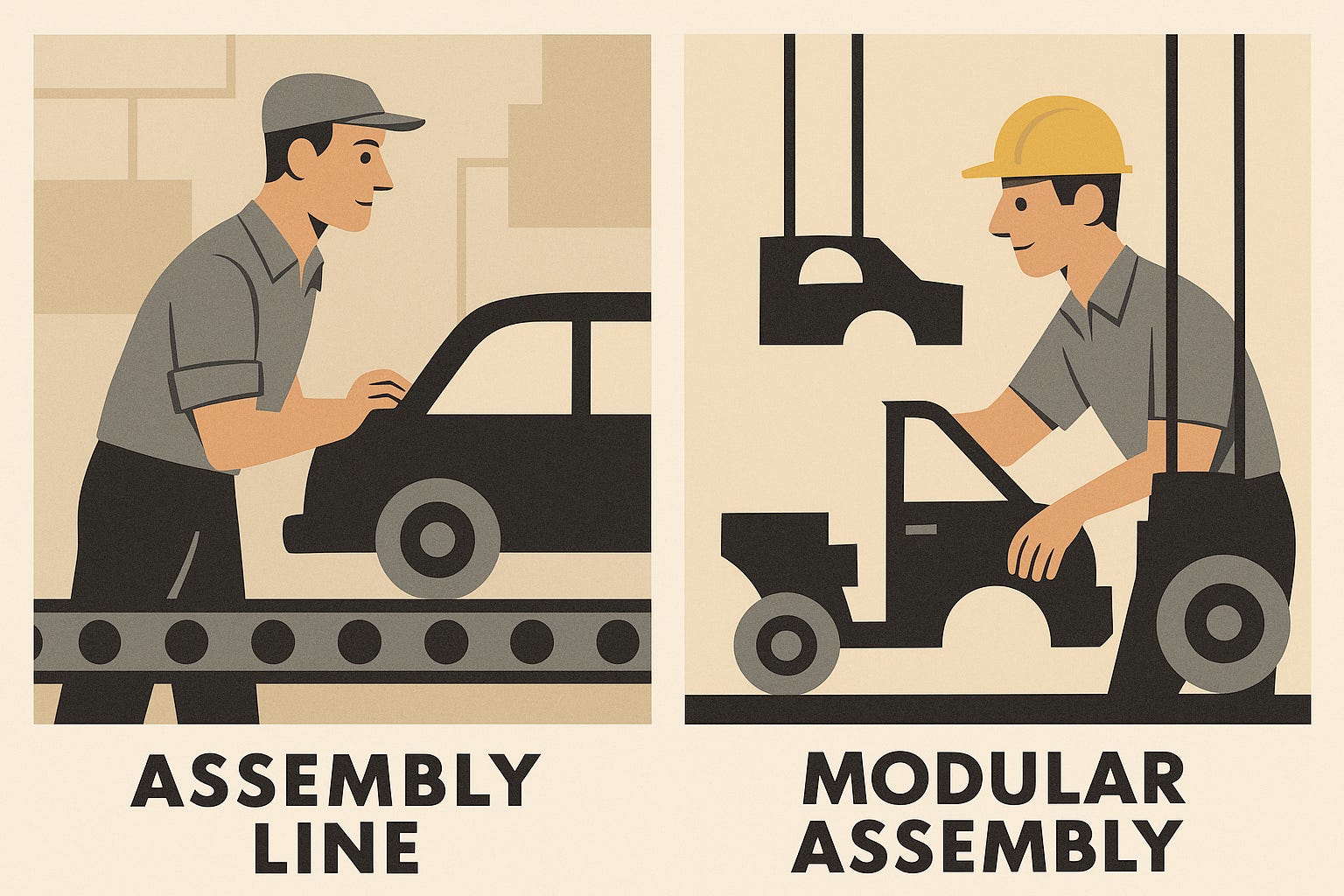
This Week’s Focus: The End of the Assembly Line?
Ford is dismantling the very system that made it famous: the moving assembly line. Its new “assembly tree” for EVs, alongside Tesla’s “unboxed” process, signals a shift from scale-driven efficiency to modular, technology-driven manufacturing, allowing subframes, gigacasting, and structural batteries—methods that could cut costs by 50% and bring $25,000 EVs within reach. The implications extend to labor, supply chains, and profitability models. But whether this marks a true post-assembly-line era or another detour remains uncertain. What is clear is that after 112 years, Henry Ford’s conveyor belt is no longer sacred.
Ford is scrapping the very invention that made it a global powerhouse: the moving assembly line.
Ford recently announced that its new “assembly tree” for EVs, is more than a production tweak—it signals that in today’s auto industry, scale no longer guarantees efficiency, and that the race to reinvent manufacturing has begun.
Let’s break it down.
Begin the Begin: From Henry Ford to the Rise of the Assembly Line
The concept of the moving assembly line revolutionized manufacturing over a century ago. In 1913, Henry Ford’s team introduced a conveyor-driven assembly line at the Highland Park plant, which allowed Model T chassis assembly time to plummet from almost 12 hours to just 93 minutes. By bringing work to stationary workers (inspired by conveyor belts used in slaughterhouses), Ford increased productivity dramatically.
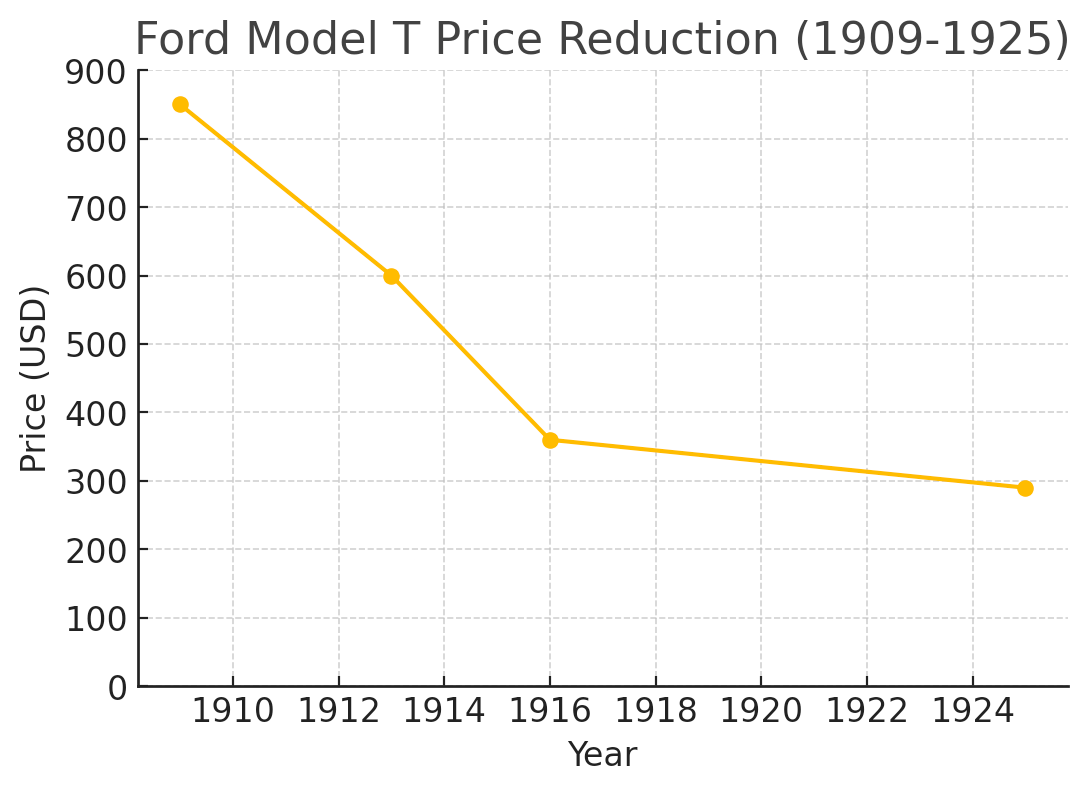
The payoff was immediate in terms of scale and cost: the Model T’s price fell from ~$850 in 1909 to only ~$260 by mid-1920. This mass production made the automobile affordable to the middle class and cemented “Fordism”—high-volume production with standardized parts and higher wages—as the dominant manufacturing paradigm.
However, the moving assembly line also highlighted labor challenges. The work was highly repetitive and tightly timed, leading to worker boredom and turnover. Henry Ford famously addressed this with the $5 workday in 1914—doubling wages to attract and retain workers despite the mind-numbing routine. In effect, Ford traded higher pay for reliable productivity. This bargain paid off as output surged and Ford’s market share soared; by the 1920s Ford produced millions of cars per year, outpacing competitors who hadn’t adopted similar methods. The assembly line had proven its worth: mass production drove down costs and scaled up output, reshaping not just the auto industry but manufacturing worldwide.
What’s the Frequency, Henry? Do Assembly Lines Scale?
Economies of scale—the cost advantages of producing in large volume—have been fundamental to the auto industry since the assembly line’s inception.
Economies of scale enable lower costs: high-volume manufacturers negotiate cheaper parts, justify expensive automation, and amortize R&D across millions of units, which translates into healthy profit margins. Ford’s Model T demonstrated this, establishing a pattern: automakers with the largest production volumes tend to achieve the lowest unit costs and often the highest margins. In the mid-20th century, this drove industry consolidation and the dominance of a few large players.
By the 2000s, productivity metrics like labor hours per vehicle (HPV) showed how far assembly line optimization had come—but also its limits. In 2006 Toyota led major automakers with about 29.9 labor hours per vehicle, with GM at 32.3, and Ford about 35.1 hours. Decades of lean manufacturing (pioneered by Toyota) had narrowed productivity gaps, but even the best factories still required on the order of 30+ hours of work per car, illustrating how conventional assembly processes, while highly refined, remain time- and labor-intensive.
So it’s clear that conventional assembly lines also have downsides. They are capital-intensive and inflexible: a traditional auto plant is laid out for a specific sequence of tasks, making it hard to adapt quickly to new designs or lower volumes. The linear assembly line’s logic is to maximize throughput of one model (or a stable mix of models), which works best when demand is large and steady. In today’s market, demand can be volatile and product variety is higher, putting pressure on the rigid assembly line model. Moreover, diminishing returns to scale can set in—beyond a point, simply making a factory bigger yields little additional efficiency, and logistical complexity may rise. This has led to exploration of more flexible production strategies (like modular assembly or micro-factories) that aim to get efficiency at lower scales. Manufacturing costs also increasingly come from high-tech components (batteries, electronics) and software development, where scale helps but innovation can matter more for cost reduction.
Losing My Religion: Why the Automotive Firms No Longer Scale
For much of the 20th century, scale was the defining advantage in the automotive industry. But the data from 2021–2025 shows that this relationship has broken down.
Despite Ford and GM both achieving record revenues (climbing back above $180 billion annually by 2024–2025), gross margins have not followed suit. Ford’s gross margins peaked near 15% in 2022–2023 but slipped to ~13% by mid-2025. GM’s margins were even more volatile: after recovering to ~14% in 2021, they fell steadily to ~11% by 2025. In other words, scale expanded, but profitability contracted.
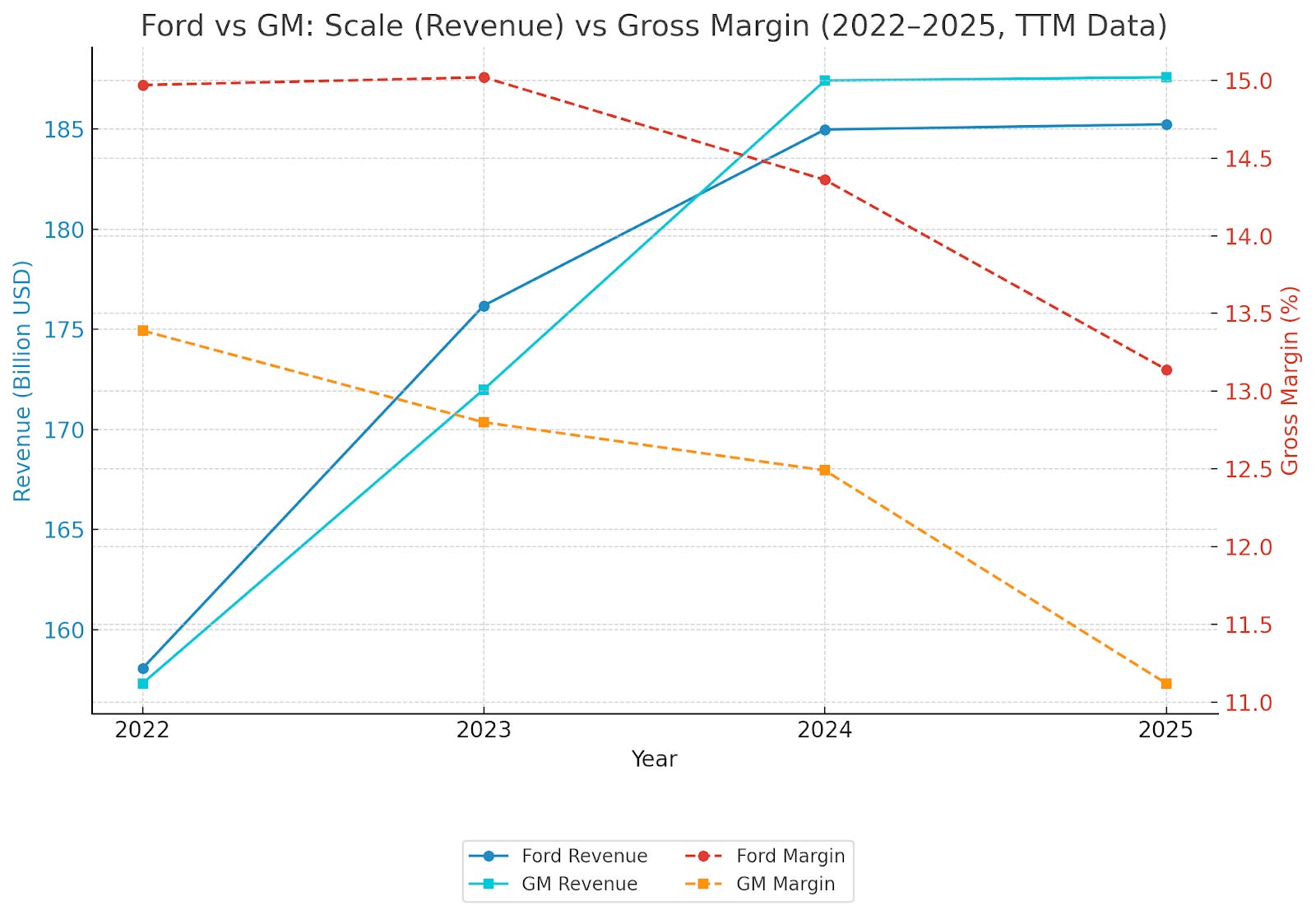
Of course, one could argue that falling margins reflect cyclical headwinds—commodity shocks, chip shortages, or pandemic aftershocks—rather than the death of scale itself. But the persistence of the margin squeeze across multiple firms and years suggests something more structural. What’s breaking is not demand, but the very link between volume and efficiency: higher output no longer ensures lower unit cost because so much of the EV cost stack (batteries, chips, software) doesn’t yield the same scale curve as stamping steel or machining engines once did. In other words, we’ve shifted from an industrial economy of scale to a materials economy of scarcity—and the old Fordist playbook doesn’t map neatly onto this terrain.
Three forces explain why scale no longer guarantees better margins. Automakers remain heavily exposed to commodity costs—spikes in lithium, steel, or logistics can erase efficiency gains no matter how many vehicles roll off the line. At the same time, the EV transition demands parallel investments in batteries, retooling, and software, costs that don’t diminish with volume and often leave early electric models margin-negative despite sales growth. Finally, competitive pressure from global rivals—especially cost-advantaged Chinese firms like BYD—forces incumbents to cut prices as they scale, often faster than they can cut costs. The result is that while revenues expand, unit economics remain under relentless strain.
The lesson is clear: in today’s auto industry, scale has diminishing returns. Profitability is no longer about how many cars a company can push off the line, but how cleverly those cars are designed and manufactured. That’s why firms like Ford and Tesla are betting on new assembly models—modular sub-assemblies, gigacasting, and structural batteries—as the new lever for cost and margin improvement.
Shiny Happy Modules: Tesla’s “Unboxed” Revolution and Lego-like CarBuilding
One company famously fixated on manufacturing innovation is Tesla.
In March 2023, at its Investor Day, Tesla revealed a radical new approach called the “Unboxed” manufacturing process (internally dubbed Global Automotive Modular Evolution, or GAME). This method essentially throws out the traditional linear assembly line in favor of a modular assembly of the vehicle in large sections—more akin to building with Lego blocks than the sequential “frame on conveyor” technique used since Henry Ford’s time. Tesla’s idea is to build the car in separate sub-assemblies (modules)—a front module, a rear module, and a battery/floor module with the seats attached—and then join those pieces together in a final step. In effect, “The vehicle assembly line has been a linear process since Highland Park. The unboxed approach allows for simultaneous sub-assemblies…,” enabling multiple parts of the car to be built in parallel instead of one car inching along a line.
The potential benefits are huge: By working on sections in parallel, Tesla claims cars can be built 25% faster and with 40% fewer workers than a conventional process. Additionally, this approach is paired with gigacasting—using giant aluminum casting machines to create large one-piece structures (like an entire rear underbody)—which eliminates hundreds of smaller parts and welds. Tesla also claims that the “Unboxed” process could halve production costs and shrink factory footprint by 40%, paving the way for its long-awaited $25,000 EV.

The industry reaction to Tesla’s plan has been mixed. Some experts hailed it as potentially “seismic.” As one manufacturing consultant put it, “[it’s] the feeling that the Toyota Production System handbook has just been thrown in the air and machine-gunned down.” Academic observers noted it could eliminate traditional steps and complexity—a truly “revolutionary” shift, if it works. Other automakers certainly took notice: reports emerged that Toyota, Ford, and Kia began exploring similar hyper-modular methods, spurred by Tesla’s competitive threat. And Chinese EV makers—already fast and agile—are said to be keen to adopt elements of Tesla’s approach as well. However, skeptics point out that Tesla hasn’t yet proven this at scale. Critics note that the “unboxed” idea is still primarily an assembly process innovation—it doesn’t overhaul everything the way Toyota’s lean system did, but rather rearranges the assembly sequence. Some warn of new challenges: precision and synchronization become critical when mating huge completed sections together just-in-time. One former Toyota engineer cautioned that if the big modules don’t arrive perfectly in sync, the whole process could falter, and fixing misalignments or quality issues in a nearly finished module might be harder. There are also technical hurdles: ensuring bolts and seals line up in those final joins, maintaining paint quality when parts are painted separately, and preventing any structural weakness at the “joints.” Tesla itself acknowledged that engineering this was “very, very hard,” highlighting issues like how to support a car body with no floor until it’s married to the battery module.
The real question is whether this is a revolution or a repackaging. Tesla’s process still depends on a synchronized flow, just chunked into larger modules. That can be a bug as much as a feature: if a $7,000 module arrives misaligned, you don’t scrap a bolt, you scrap a third of a car. In that sense, the “unboxed” process trades dozens of small risks for a handful of catastrophic ones. As one former Toyota engineer put it: “This is less about eliminating complexity than about moving it around.”
As of mid-2025, Tesla’s fully modular line had not yet gone live—it’s reportedly testing elements at its Texas Gigafactory and planning implementation in Mexico and its future small car (often dubbed Model 2) by 2025-2026. In fact, in an interesting twist, Ford may beat Tesla to the punch in actually deploying a three-module assembly system on a production vehicle. Tesla “talked about doing something like this in 2023…but hasn’t done it yet,” Wired noted, whereas Ford is gearing up to launch a vehicle with this approach in 2027. Nevertheless, Tesla’s unboxed concept has undeniably forced the industry to ask: Can we finally move beyond Henry Ford’s assembly line? If Tesla’s vision holds true, the result would be not just cheaper EVs, but a wholesale change in how cars are built—with broad implications for factory design, labor, and competitive dynamics.
Orange Crush and Ford’s Assembly Tree: Rethinking EV Manufacturing
It is fitting that Ford—the same company that pioneered the moving assembly line—is now spearheading a dramatic overhaul of that very system. In August 2025, Ford announced a $2 billion investment to transform its Louisville Assembly Plant for a new generation of affordable EVs, using what it calls a “Ford Universal EV Production System.” In essence, Ford is throwing out Henry Ford’s assembly line in favor of a three-pronged “assembly tree.” Instead of one vehicle moving down a single line, three sub-assemblies are built in parallel—the front, the rear, and the middle (including the battery and interior)—which are then bolted together at the end. Ford CEO Jim Farley described it as “a completely new way to make a car… No one’s ever built a car that way.”
At the core of this system is a brand-new EV platform designed for modular assembly. Ford’s approach uses large single-piece aluminum castings (similar to Tesla’s gigacasting) for the front and rear sections, eliminating dozens of parts in each. The center section is dominated by a structural battery pack—using cheaper lithium iron phosphate (LFP) cells—that doubles as the vehicle floor, onto which the seats, carpeting, and center console are pre-installed. This means the interior can be built up on the battery “skateboard” outside of the car’s body, rather than workers contorting inside a narrow cabin to install components. This greatly improves ergonomics and safety for workers. In fact, Ford worked closely with its union (UAW) on the redesign, and union leaders praised that “twisting, turning, and bending” are dramatically reduced for assembly workers.
The efficiency gains Ford cites are quite promising. The first vehicle to use this system—a mid-sized electric pickup truck slated for 2027—will have 20% fewer parts than a comparable EV today. In particular, Ford says it slashed 50% of the cooling hoses and 25% of the fasteners (bolts, nuts, clips) in the design. By bolting together three large modules, Ford can avoid the traditional slow crawl of a chassis through dozens of stations. Instead, three teams work in parallel, and the final join marries the sections. According to Ford, this “universal” EV platform and production system will be about 15% faster overall, with comparable quality, while enabling a targeted base price of $30,000 for that electric pickup—a price point they need to compete with Tesla and Chinese rivals.
Ford’s initiative was born out of urgency.
The company’s EV division has been losing billions (over $5 billion in 2024 alone, and further $1.3B loss in Q2 2025) while EV sales (of its Mustang Mach-E and F-150 Lightning) have underwhelmed. To compete in the impending market for mass-market EVs, Ford recognized it cannot simply rely on scaling up the old assembly paradigm. Chinese automakers like BYD have massive scale and cost advantages (BYD is vertically integrated and employs some 700,000 people, including 200k engineers). “We can’t beat them on scale. We can’t beat them on vertical integration. But we can beat them on innovation,” Farley admitted. In other words, Ford is betting on process innovation over sheer volume. By building cars in a new way, they aim to achieve a step-change reduction in cost and time—effectively leapfrogging the traditional assembly line, which China’s giants have mastered. It’s telling that Ford likened this project to their Model T moment—a gamble with no guarantees, but potentially transformative.
Labor is one area of risk and opportunity. Ford’s new Louisville setup will ultimately require about 25% fewer workers (roughly 600 fewer on ~2800), due to higher automation and efficiency. Notably, Ford negotiated early with the United Auto Workers union to manage this change: offering retirement packages and reassignments to affected workers. The UAW, rather than oppose, has cautiously supported the move—emphasizing that it preserves U.S. jobs by keeping Ford competitive and that it will “improve safety and ergonomics” for those on the line. This partnership approach (in stark contrast to the adversarial tone one might expect when automation reduces headcount) suggests Ford sees the assembly tree as essential for its survival, and the union concurs that some innovation is necessary to build EVs affordably in America. As one UAW representative put it, “we have to make money from this project for jobs to stay in America… This isn’t optional.” The hope is that by leading this manufacturing change, Ford can protect its longer-term workforce by avoiding ceding the EV market to overseas competitors.
What makes Ford’s “assembly tree” different from Tesla’s Lego pitch is not just engineering, but sociology. Tesla tells a story of speed; Ford is telling a story of a new compact between capital and labor. By co-designing the process with the UAW, Ford has managed to turn what might have been a story of job loss into one of safer, less punishing work. In that sense, Ford may be closer to rediscovering the original “Fordist bargain”—not $5 a day for drudgery, but tolerable work in exchange for stability in an era of automation.
The deeper question is whether this represents a new equilibrium: fewer jobs, but better ones. Early Fordism bought loyalty with higher wages; late Fordism may buy it with ergonomics and co-determination. Whether that is enough to anchor the middle class in the way Henry Ford once did remains uncertain. If the assembly tree proves profitable, Detroit may have found a way to keep jobs onshore—just not as many of them.
The End of the Line as We Know It (And I Feel Fine?)
Ford and Tesla’s moves raise an important question: Are we witnessing the beginning of the end for the traditional moving assembly line?
After 112 years of incremental tweaks to Henry Ford’s production system, it seems like a paradigm shift is underway. The evidence suggests that for next-generation electric vehicles, the old assembly line is reaching its limits. EVs, which have fundamentally simpler powertrains (no multi-part engines or transmissions), offer an opportunity to redesign the whole car and its assembly. Tesla and Ford’s strategies both capitalize on this simplicity: large casted subframes, structural batteries, and modular sections—none of which would be as feasible in the old gasoline vehicle architecture. In a sense, the product (EVs) is enabling the process (modular assembly), and the rewards for doing it right are huge: faster production, lower cost per unit, and the ability to profitably sell EVs in the $25–30k range—crucial for mass adoption.
If Ford’s “assembly tree” and Tesla’s “unboxed” process succeed, the implications could be immense: cost reductions of up to 50% may finally bring $25,000 EVs within reach; labor will shift from repetitive line work toward more technical oversight, with fewer but more skilled jobs; and supply chains will be reshaped as automakers demand larger pre-assembled modules or bring more fabrication in-house. Instead of sourcing thousands of discrete parts, companies will orchestrate the delivery of mega-subassemblies—raising the stakes for coordination but reducing complexity. The traditional single-file assembly line will persist for some vehicles, but the industry’s center of gravity is already shifting toward modular networks and automation. After more than a century, Henry Ford’s invention is giving way to a post-assembly-line era—one where survival depends less on sheer volume and more on reinventing both how cars are built and how supply chains are structured.
And yet, for all the bold claims, we don’t know if these experiments will stick. Tesla has yet to prove it can unbox a car at scale, while Ford is betting billions on a tree that has never borne fruit. Both are gambling that cleverness can beat volume—a wager that history has not often rewarded in the auto industry.
So is this the dawn of a post-assembly-line era, or just another detour on the long road of industrial evolution? The only thing certain is that the conveyor belt—the symbol of 20th-century scale—is no longer sacred. It may be the end of the line as we know it. But whether anyone feels fine about that will depend on who wins, who adapts, and who gets left behind.
Loved this. Can't wait to read your sequel, Man on the Moon. Something tells me that will require rethinking some of the constraints and assumptions of earthbound manufacturing!
I am also excited about Slate Auto, since they are only producing a single stripped down SKU, and the body will largely be injection molded. Owners then can customize.