
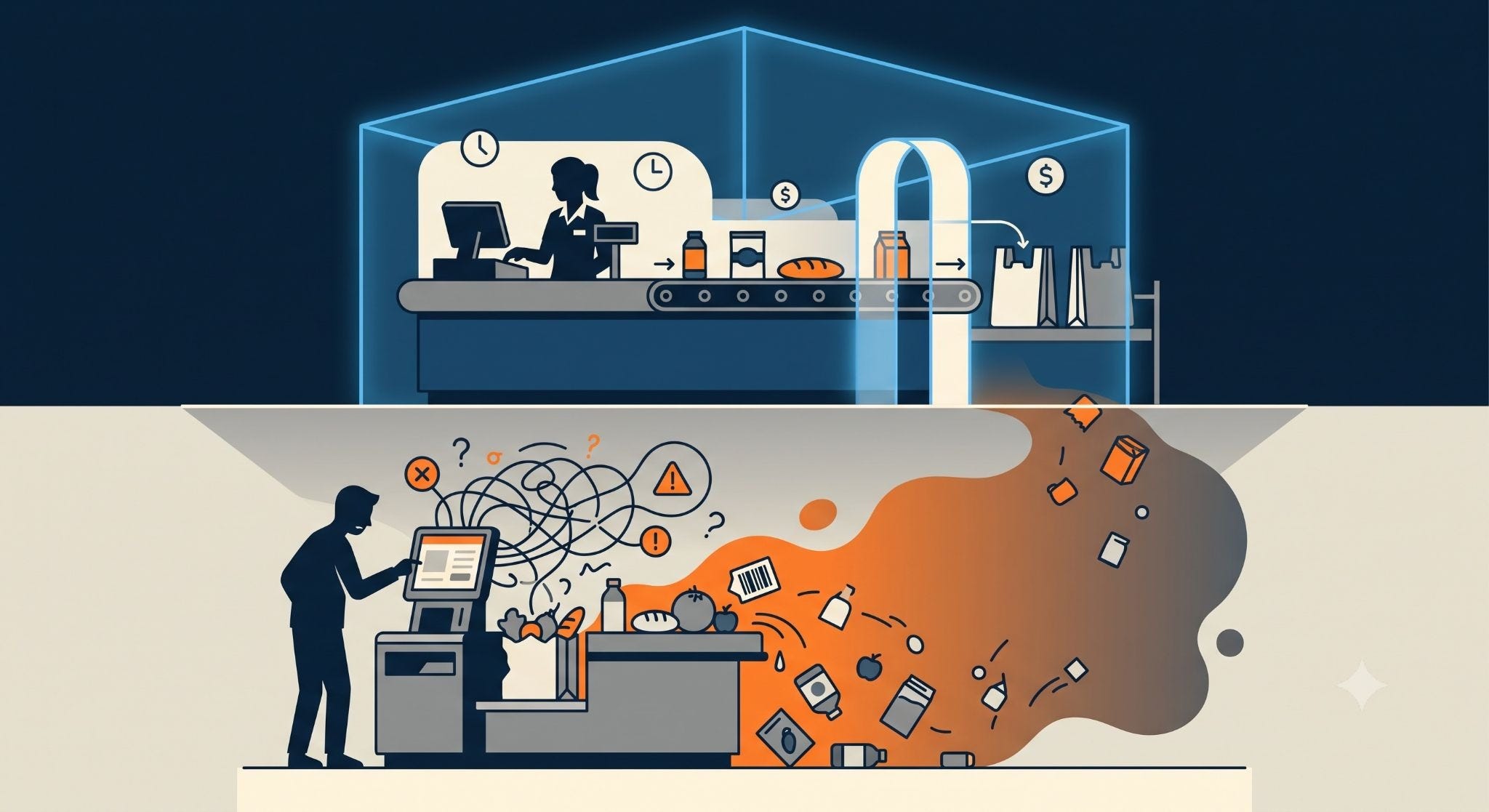
This summer, several American cities and states decided that the real problem with self-checkout is that there isn’t enough government in it.
Long Beach and Costa Mesa have passed ordinances. Ohio and New York City have bills moving. Seven states now have measures in place or proposed that would require grocers to keep a human lane open, cap self-checkout at around 15 items, and post one employee for every 3 kiosks.
Long-time readers of this newsletter know my biases up: I have HATED self-checkout for years, on the record, more than once.
And I hate these laws more than I hate the machines.
A city council that will draft a statute to save me from the ordeal of scanning my own yogurt has too much time and too little to do. If a store wants to annoy me at checkout, that is between me and the store, and I am free to shop somewhere else.
The number that should have ended the argument is not so subtle: A self-checkout lane loses about 3.5% of sales to shrink against roughly 0.2% at a staffed lane, a 17-fold gap. That is why, quietly and without any help from the city council, a $30 billion company already made the call.
On its Q1 2024 earnings call, Dollar General said the word “shrink” 38 times and announced it was pulling self-checkout out of the vast majority of its stores, roughly 12,000 of them. Walmart, Target, and others have been capping or removing lanes on their own.
The market was already unwinding this bet.
The legislators are late and about to take the credit.
I Argued the Wrong Case in 2021
In 2021, I made a queueing argument: when a store gets congested, shoppers drift from the long cashier line to the kiosks, where service is slower and more variable than with a trained cashier. The outcome is that average processing time and variance go up, and variance is particularly poisonous when the system is already overloaded.
And indeed, Research in Management Science, using in-store video, has shown that a longer checkout queue measurably depresses what customers buy.
I still think all of that is correct. I have stood at enough kiosks listening to “unexpected items in the bagging area” to believe it in my bones.
I was not wrong so much as incomplete.
The queue was real, and the misery was real, and I will come back to how much these machines annoy the people forced to use them.
But congestion alone would never have killed self-checkout.
What actually broke the strategy was that the same design that irritated the shopper at the front of the store was quietly wrecking the inventory accuracy at the back of it.
In other words, the annoyance and the shrink arrived together, and the shrink was the half that showed up in the numbers. (No one really cares about an annoyed customer.
What the Cashier Actually Did
Let’s take the job apart. When a trained employee sits at the lane, the single act we call “checkout” is bundling at least five different jobs into one wage:
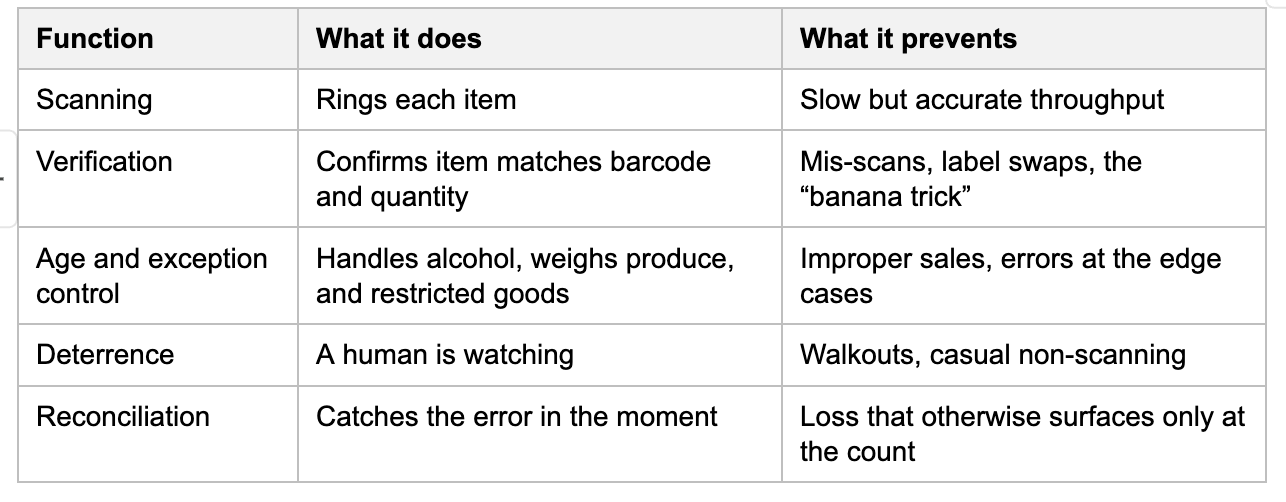
Self-checkout was sold as the automation of the first item.
In practice, it deleted the bottom four.
The customer inherited scanning and verification, which they do badly and have no reason to do well, and the deterrence and reconciliation functions simply vanished. Nobody is watching, and nothing is caught while it can still be fixed.
This is not unrelated to the idea of operational transparency: Field experiments in Management Science found that letting customers and employees see each other did not degrade the work, as older theory predicted. It raised service quality by about 22% and cut throughput time by about 19%.
The cashier was providing that transparency: a two-way channel where the worker watched the basket and the customer felt watched.
That 17-fold loss gap I mentioned above is where the deletion shows up. The careful store-level work here comes from the ECR Retail Loss group and the criminologist Adrian Beck, who instrumented real stores instead of guessing. Stores pushing 55 to 60% of transactions through fixed self-checkout could expect total shrinkage about 31% higher than the industry baseline, and stores with an above-average number of machines could expect 60% higher or worse. Even the gentler “scan and go” mobile systems pushed shrink up about 18%.
I am not sure I fully believe this number, but current estimates suggest that roughly 52% of self-checkout losses are accidental and 48% are malicious. Most of the leakage is not theft at all. It is an error. It is the produce code nobody enters, the second item hiding under the first, the barcode that will not read, and the shopper who shrugs and moves on.
A cashier corrects those mistakes a hundred times a shift, and nobody calls it loss prevention.
The Cost Did Not Disappear.
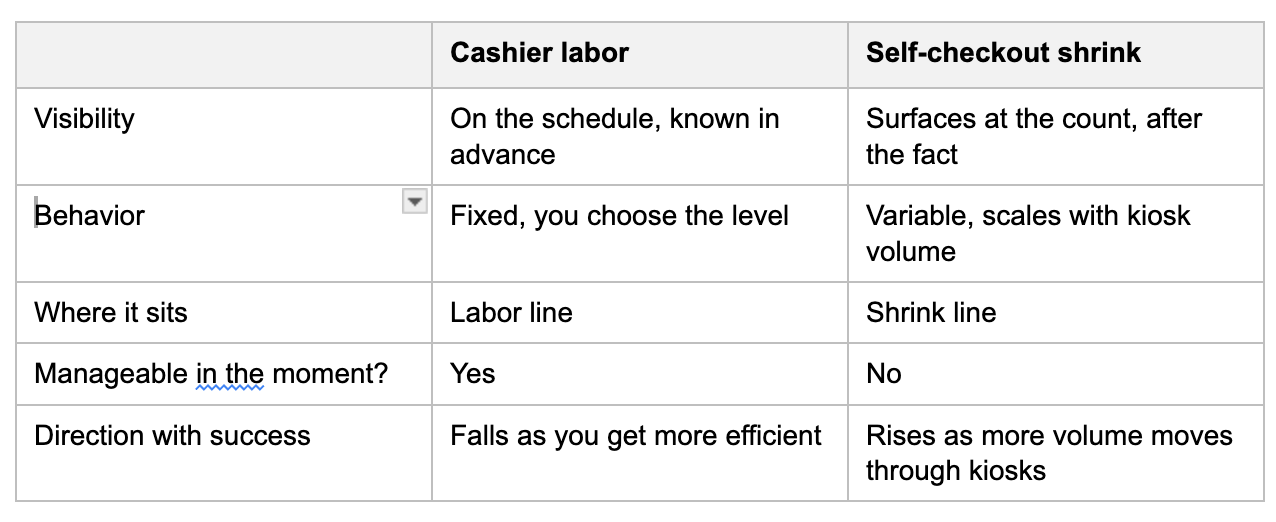
The American cashier earns about $14.77 an hour, call it $30,000 to $40,000 a year fully loaded. It sits on the labor line. It is fixed, scheduled, and forecastable.
Shrinkage is a cost you cannot see until it is too late to do anything about it. It surfaces weeks later when the physical count disagrees with the system, by which point you cannot point to a transaction, a person, or a cause. It is variable, it is lumpy, and it is close to unmanageable in the moment because, by definition, you did not notice it happening.
A Management Science study of nearly 370,000 inventory records found 65% of them were inaccurate, and the inaccuracy got worse as the store environment got more complex.
Later work in the Journal of Operations Management traced a large share of that inaccuracy to labor: thin the people who keep the records true, and the records drift. Retail-labor research points the same way from the other side, finding that more store labor raises profitability through conformance quality, the unglamorous business of keeping the shelf, the system, and reality agreeing with each other. Self-checkout is a deliberate cut to exactly that labor.
The self-checkout converted a visible, schedulable wage into an invisible, variable loss rate. That trade looks great on a quarterly labor slide and turns into a disaster on the annual shrink reconciliation, because the two numbers live in different corners of the P&L and almost never get put on the same page by the same person.
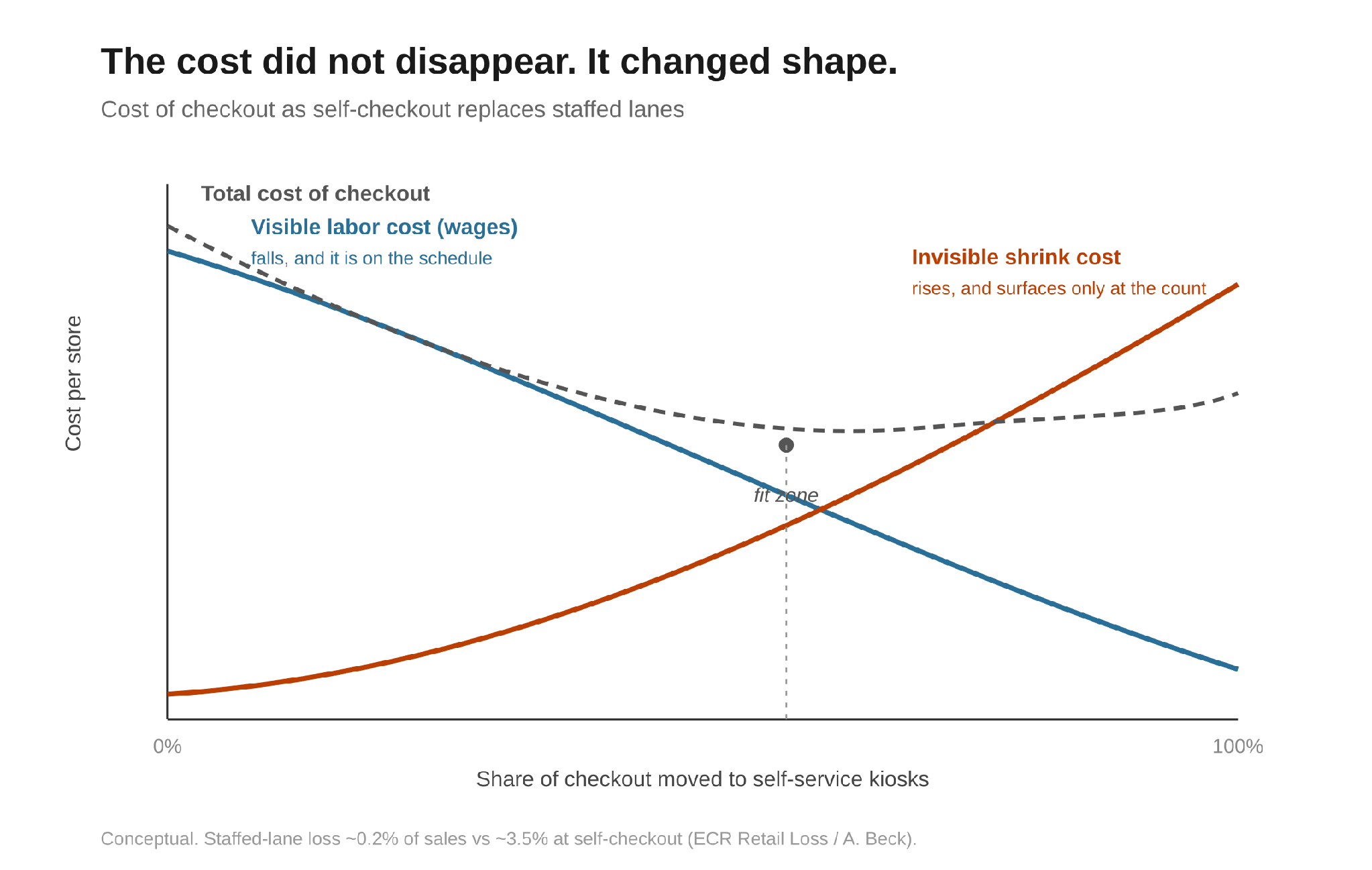
The arithmetic is not subtle once you write it down: Suppose one self-checkout attendant covers six lanes and replaces most of the six cashiers. A cashier costs about $30,710 a year, so six of them is roughly $184,000, against one attendant at maybe $35,000. Call the gross saving $150,000. Now run those six lanes at 3.5% loss instead of 0.2% on the sales flowing through them. That extra 3.3 points of shrink eats the entire $150,000 at about $4.5 million of annual self-checkout volume, which a busy supermarket clears through a kiosk bank without breaking a sweat. Past that point, the lanes are losing money against the cashiers they replaced. And unlike the labor line, the loss grows with sales instead of shrinking with efficiency. The better the kiosks work, the bigger the leak. That is the opposite of how a cost structure is supposed to behave.
A self-checkout unit costs $1,500 to $20,000, a one-time cost that amortizes over time. The recurring cost is the shrinkage.
U.S. retail shrink hit $112 billion in 2022, up from $94 billion the year before. One caveat, and it cuts both ways: the National Retail Federation discontinued its 32-year shrink survey in 2024 over methodology problems, so the cleanest aggregate number is now a few years stale. The store-level instrumented studies are the better evidence anyway, and they all point in the same direction.
The Wrong Villain
Through 2022 and 2023, the talking point was about theft rings, smash-and-grabs, a lawless society. Target said petty theft and organized groups had dented its profit by more than $500 million.
The National Retail Federation told everyone that organized retail crime accounted for nearly half of all shrinkage. Half.
Then, in late 2023, the NRF quietly retracted that claim (much more quietly than the original story). The real organized crime share of shrink was closer to 5%, not 50%. Walgreens’ own CFO admitted the company “cried too much” about theft. Analysts at William Blair concluded chains had overexaggerated the impact and used it as cover for inventory mismanagement and strategic mistakes.
The reality is that a meaningful chunk of the shrink retailers pinned on criminal gangs was manufactured by their own checkout design, and the behavior it produced is not coming from where they said. Look at who is actually doing it.
In a 2024 survey, 27% of self-checkout users admitted to deliberately not scanning an item, up from 15% a year earlier. Households earning over $100,000 were twice as likely to steal as households earning under $50,000.
This is a behavioral response to a machine that hands an ordinary, basically honest shopper an honor system and an unlocked door, and then trusts them to police themselves at the end of a tedious chore.
The theory of self-concept maintenance describes ordinary people who cheat just enough to come out ahead while still feeling honest, and who do it most freely when moral attention is low, and the categories are fuzzy.
In other words, a self-checkout is a machine for lowering moral attention. Is leaving the bagged avocado unscanned really stealing, or did the machine just miss it? The fuzziness is the point. In fairness to the academic record, that specific result has since faced replication challenges, so I lean on the broad and well-supported claim rather than the exact effect size: monitoring shapes honesty, and self-checkout removed the monitoring.
If you build a system that assumes everyone is honest, point a weak camera at it, you will discover how conditional most people’s honesty actually is.
By taking the cashier away retailers changed the customer. Then they took that self-inflicted loss to the legislature and lobbied for tougher criminal penalties on shoplifters, asking the public to fund the policing of a problem they had engineered to save on wages.
They built the leak, and then went looking for someone else to blame for the water.
Why the Obvious Fixes Keep Failing
Target imposed a hard 10-item limit on self-checkout across about 2,000 stores.
Walmart restricted many lanes to 15 items.
Stores added receipt checks, weight sensors, overhead cameras, and attendants posted to approve alcohol and clear errors.
Each fix re-adds a piece of the control system the cashier used to provide for free.
The theory predicted this. A Management Science model of self-order technology reached a conclusion that under plausible conditions, a firm adopting it should actually raise its staffing, and the result holds specifically for firms with high labor costs.
The kiosk does not require a worker. It moves the worker to where the new failure modes are, if management is paying attention. Most were not, which is why the workers came back as loss-prevention attendants instead of cashiers, doing a worse-defined version of the same job.
The fixes also backfire, and again, the research is ahead of the retailers. Work in the Journal of Marketing shows that when customers co-produce, they take the credit when things go well and blame the firm when they go badly.
So you have handed the shopper the labor, and you have also handed them a grievance: they did your job, and now a receipt-checker treats them like a suspect on the way out. Beck has a useful term, “design fatigue,” for the moment a shopper gets sick of the nagging machine and just walks out, sometimes with the cart.
Every gram of friction you add to plug the leak also creates more of the irritation that drives walkaways and the resentment that shows up in your satisfaction scores.
In the 2025 ACSI retail study, Costco slipped 2%, and Target slipped to 80, while Sam’s Club rose 5%, helped by a Scan & Go system that works precisely because it is tied to a verified membership and a small, identified basket.
Target called its 10-item express lanes a success: average transaction time down nearly 8%, net promoter score for checkout wait up 5 points. A self-checkout lane, restricted to a small, predictable basket, with staffed lanes handling everything else.
They rediscovered … the cashier.
Which brings us back to those bills I mentioned at the start.
Strip away the politics and read what the laws actually require: one staffed lane, one worker for every three kiosks, a cap of around fifteen items.
The General Lesson
My world view is narrow. I view everything through the lens of constraints.
The constraint in a checkout line was never the cashier’s wage. The binding constraint here was always trust and exception-handling, neither of which fits on a kiosk.
Retailers spent fifteen years optimizing the cost they could see and ignoring the one they could not, because the visible cost printed a number every two weeks and the invisible one stayed quiet until the count.
When you automate a job by handing the work to a party with no stake in doing it right, you essentially relocate it to a place in your books where you can no longer see it, manage it, or even prove who caused it.
You cannot legislate a number onto a P&L.
Self-service creates value when you put it at an upstream step that is rich with choice, where the customer wants to browse and will happily spend more doing the work themselves.
The McDonald’s kiosk lives there, which is why people order 12 to 20% more from it than from a cashier.
It destroys value when you put it at a downstream control step like the final scan, where the only jobs left are verification and trust, and the customer has no reason to do either well.
Retail did not adopt the wrong technology.
It bolted the machine to exactly the wrong place in the line.
Hi Dr. Allon, I appreciate your insights into automation and it's relationship to human behavior! This seems to be a precursor to possible challenges we may face in coming months / years as we rush to apply AI in every possible business solution.
I Ioved reading this as I'm a student of grocery stores and I never miss a chance to visit them when travelling.
It would be interesting to know more about the nature of the errors at self-checkout. I'd guess the errors of ringing up 'broccoli' instead of 'broccoli crowns' or 'honeycrisp apples' instead of 'organic honeycrisp apples' is as large a problem as the outright theft.
My Mariano's/Kroger recently converted to electronic shelf-tag pricing. One bug that I've noticed is sometimes the electronic records and actual inventory are out of sync and the tag will display 'sorry we're out of this item' when I can clearly see the item on the shelf. Of course no price is displayed so I have to assume it's another over-priced item so I pass on the purchase.