The USMCA Countdown Is a Trap


On June 30, 2026, at the first joint review of the United States-Mexico-Canada Agreement, Washington declined to extend the pact, setting the clock ticking.
This is not yet a termination. The sunset clause built into the agreement now runs for a decade, with annual reviews, until it expires on July 1, 2036, unless all three governments agree to renew it first.
If you want to understand the scale, the agreement governs roughly $2 trillion in trade annually.
The market reads the headline the way it reads most trade news. And as usual, it highlighted a number … ten years.
That sounds like a long runway.
Everyone is calling this a reprieve: A decade to adjust, relocate, wait it out.
I think that is the mistake.
The comforting story is that a slow wind-down beats a cliff. And clearly, there is something to it: Ten years to move a plant beats ten weeks.
But gentle is not the same as cheap, and long is not the same as certain.
The countdown does not address what North American trade will look like in 2032. It guarantees the question stays open and repriced, every day for ten years.
A cliff you can hedge.
A slow bleed, you just stand there and watch.
My claim is simple: Resilience is being priced wrong.
Firms and markets are valuing this as a change in the expected cost of a landed good due to tariffs.
But that is not what decides who survives the decade.
What really decides it is the variance, the correlation of the shocks, and the option value of being able to move. Those are second-moment problems. And as usual, almost nobody is pricing the second moment.
Thirty Years of Building the Thing We Are Now Unwinding
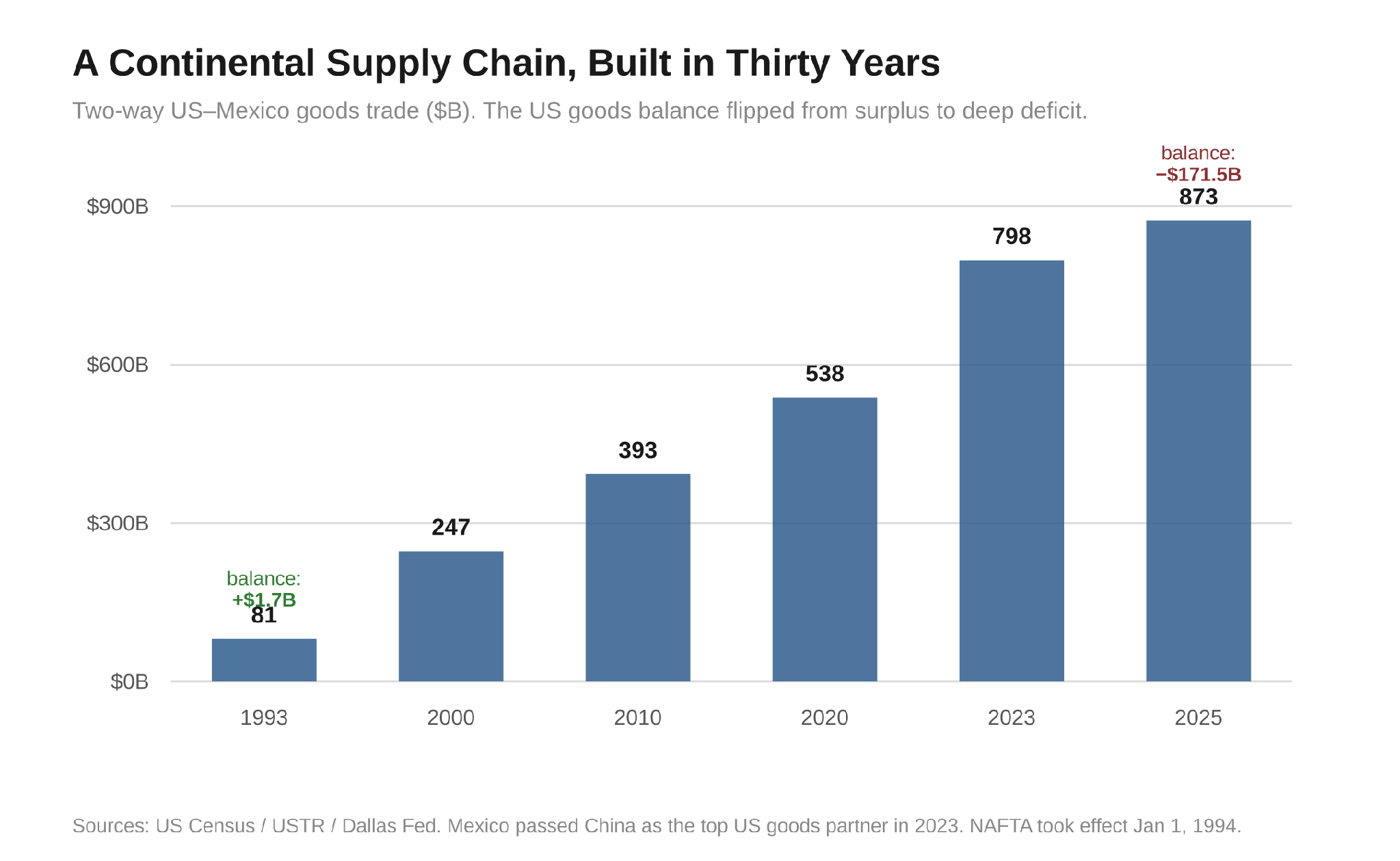
NAFTA took effect on January 1, 1994. The year before, the US and Mexico traded about $81 billion in goods, and the US ran a small surplus of $1.7 billion.
Interestingly, by 2025, the two countries traded 872.8 billion; Mexico had passed China as the largest US trading partner, and that surplus was a deficit of 171.5 billion.
Mexican exports, already 83% US-bound in 1993, grew more than 475% in NAFTA’s first fifteen years. The agreement did exactly what it was built to do. It fused three economies into one production system.
T
The academic record is (unusually) clean on this, because NAFTA is the case that a generation of trade economists used to calibrate their models.
Caliendo and Parro, in the Review of Economic Studies in 2015, produced the canonical estimate: intra-bloc trade up by 118% for Mexico and 41% for the US, and welfare up by 1.31% for Mexico and 0.08% for the US.
Critics quote that tiny US number, but the number misses the reality that the dependence is deeper than the trade totals show.
Alonso de Gortari, using 2019 Mexican customs microdata, found that Mexican exports to the US are largely composed of American parts. Standard accounting puts the US content of Mexican-manufactured imports near 18%.
The actual customs records put it closer to 30%. A large share of what the US “imports” from Mexico is American work that crossed the border, took on value, and came home.
A tariff on Mexican goods is partly a tariff on the United States. This is not a Mexican supply chain against an American one. It is one chain that happens to straddle a line on a map.
None of this was free, and pretending otherwise is part of how we got to June 30.
Hakobyan and McLaren, in a 2016 article in the Review of Economics and Statistics, set out to examine the effect of NAFTA on American workers.
For most, nothing.
For blue-collar workers in the most import-exposed towns, wage growth fell by as much as 8% over the decade.
In other words: small diffused gain, large concentrated loss.
That is the political physics that makes a trade deal easy to sign but also hard to keep, which is exactly why Washington is walking away.
There are three clear grievances:
The deficit (because a 171-billion-dollar shortfall is a number a politician can wave), China (because Mexico looks like a backdoor for routing Chinese goods and Chinese content into the US under a North American label), and the rules of origin (that are seen as too easy to game).
But the real reason is structural, and simpler than any of them: A rules-based treaty is exactly what a trade policy built on discretionary pressure cannot live with. You cannot swing tariffs week to week if you have signed a document promising not to.
The agreement is being killed because it …. worked.
A deeply integrated, rules-governed, hard-to-weaponize supply chain is precisely what a policy that wants trade as a weapon cannot afford.
The Number Everyone Is Watching Is the Wrong Number
Give the market its due. Firms respond to tariff levels, and they respond fast.
As the gap between qualifying and non-qualifying auto goods widened through 2025, USMCA utilization among Mexican exporters jumped from 44.8% in January 2025 to about 85% a year later.
.
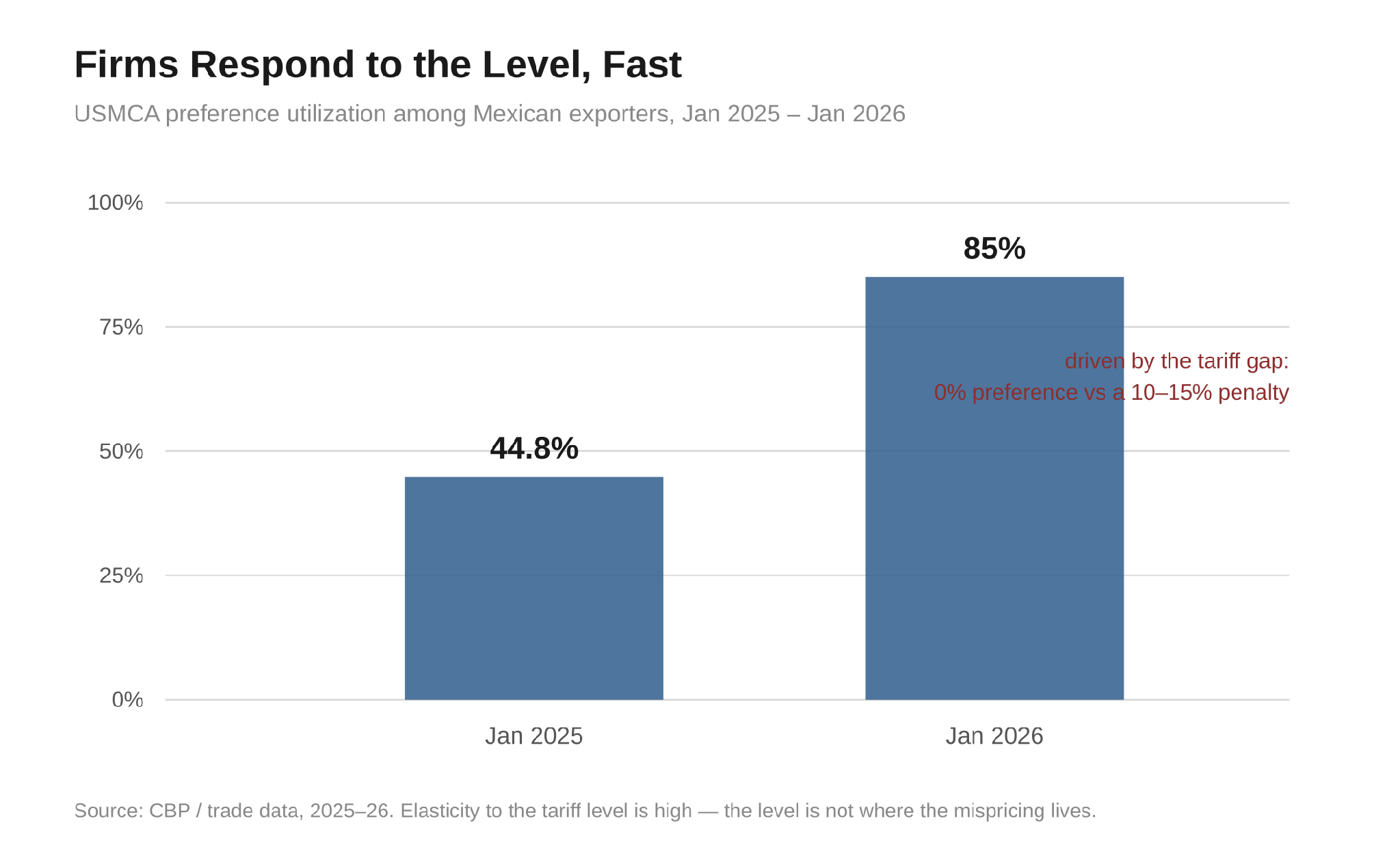
Utilization tracks the tariff gap almost mechanically. The level is visible, and firms respond to it fast.
So the level is not the mispricing. Everyone can see the level.
The mispricing is the cost that never shows up as a tariff line.
The Federal Reserve put a number on it in July 2025: the pure burden of proving USMCA origin, as an ad valorem equivalent, runs 1.4 to 2.5 percent, or 39 to 71 billion dollars a year for manufacturing.
That is coming from documentation, tracing, auditing, the labor of proving where a transmission was actually made. It is a tax on complexity..
In 2024, vehicle and parts trade across the three countries ran near 270 billion dollars. Mexico shipped an estimated 3.39 million light vehicles in 2025, roughly 78% to the US, and made about 119 billion dollars of auto parts, exporting 103.5 billion, roughly 87% north.
For example, a single part can cross the border several times before it is a car.
The 75% regional value content rule, the 70% North American steel and aluminum rule, and the labor-value-content requirement pegged to a sixteen-dollar wage all assume a border that barely exists.
Remove the legal certainty that barely exists, and you do more than add a tariff.
You tax every crossing, and you tax hardest the products that cross the most. Depth was the selling point. Now depth is the exposure.
Gao, Simchi-Levi, Teo, and Yan, in Operations Research in 2019, built the Risk Exposure Index on a single, deceptively simple parameter: time-to-recovery. Their point, first worked out with Ford, is that the risk in a supply network is rarely where the money is. It sits at the node that takes the longest to recover, and that node is usually some cheap, reliable, single-sourced supplier nobody flagged. A cross-border, single-sourced component under a stable USMCA was that node: cheap, reliable, invisible.
Exit blows up its time-to-recover, because the legal certainty that lets you single-source across the border is the thing being taken away, a second-moment shock in a first-moment costume.
Mexico Was the Hedge. Now It Is the Risk.
For five years, the resilience playbook had a very simple name: China-plus-one. Get enough production out of China that a shock to China will no longer kill you.
For North American firms, the “one” was Mexico, by a wide margin, and nearshoring was sold as a resilience move: Shorter lead times, less Pacific exposure, and it sat inside a trade deal that made it as safe as domestic.
The catch is the word “safe.” Diversification cuts risk only when the same force does not drive the things you spread into: Pool two things that move together, and you have not diversified. You have concentrated and told yourself a story about breadth.
Move production from China to Mexico to dodge US trade policy, and you have made one specific bet: that US policy toward Mexico and US policy toward China are uncorrelated.
USMCA exit is the event that calls the bet: The thing firms were hedging against, discretionary US trade action, is now the thing that governs the hedge. The correlation of the whole strategy needed to stay low just went to one.
This is what optimization models miss because most treat country risk as an independent draw per location. Add a country, cut your variance.
But the variance cut depends on the correlation matrix, which is not fixed.
It is set by policy.
When Washington turns North American trade into one instrument of pressure, it collapses the independence that made your second and third sources worth anything.
Let’s take a simple example: Two suppliers with a correlation of 0.2 reduce disruption variance by about 40% compared to a single source.
However, at 0.9, the benefit is basically gone.
Reshoring and nearshoring into a politicized trade regime do not just fail to help. They push the correlation toward 1 while the firm still records the resilience benefit as if it were near zero.
This is a simple example, but Tomlin’s 2006 paper makes this case more rigorous. Optimal sourcing is a step function of disruption risk. Low risk, single-source with a lean buffer, genuinely optimal. Higher risk, the optimum flips to multi-sourcing with contingent capacity you can switch on. And the flip is driven by how often and how long disruptions last, not by their average cost.
USMCA exit is a regime change in that parameter. Networks that were correctly single-sourced across the border under the old regime are now on the wrong side of Tomlin’s line, and the cost of switching sides is enormous and already sunk.
Firms did not build the wrong network.
They built the right network for a world that just ended.
It Was Always About China
Strip out the deficit rhetoric, and the USMCA fight is in fact a China policy wearing a North American hat.
The main items in the review, which are the tighter rules of origin, the transshipment provisions, and the talk of screening foreign investment, are not really about Mexico. They are about what enters the United States through Mexico. Washington’s fear is plain: that Mexico has become the side door, a place to assemble Chinese parts, apply a North American label, and cross the border tariff-free.
The reality is that the fear is not baseless.
Chinese investment in Mexico’s auto parts and electrical components sector surged 77% over the past year, reaching $3.9 billion by May 2025. Chinese automakers spent 2023 and 2024 scouting Mexican plant sites. If your goal is to keep Chinese content out of American cars, a Chinese factory in Monterrey building the parts is exactly the loophole the auto rules were written to close.
But as usual, the evidence is messier than the politics.
In the aggregate trade data, there is little sign of large-scale transshipment: China’s exports to Mexico actually fell 1.2% in 2025. The backtrend door is a trend, but thin when you look at the metrics, which means the rules are being tightened against a threat that is more anticipated than documented, and that is a bad combination to plan against. You get a regulation calibrated to a fear.
The deeper point is macro. Laura Alfaro and Davin Chor documented the Great Reallocation, a topic I served before. US sourcing is shifting from China to Mexico and Vietnam, but with a caveat: Mexico and Vietnam are themselves importing more from China. “Made in Mexico” increasingly means assembled in Mexico from Chinese inputs. The reallocation shifted final assembly, but in fact increased dependence on China and lengthened the supply chain, making it more fragile.
A firm that moved from China to Mexico to escape US-China tension relocated into the exact jurisdiction Washington is now rewriting to fight China, and it likely carried its Chinese inputs along for the ride. It is the original China exposure, now sitting one tier upstream, plus a fresh layer of US-Mexico policy risk stacked on top. Two correlated risks are considered diversifiable.
There is a cleaner way to see the China-Mexico relationship, using the framework Jan Van Mieghem and I built for exactly this problem. In global dual sourcing, the efficient structure is a tailored base-surge policy: cover the steady, predictable base demand from the low-cost offshore source, China, and meet the volatile surge from the responsive nearshore source, Mexico.
In that model, China and Mexico were complements, each doing the job it is built for, cheap-and-slow against fast-and-flexible. The value of the nearshore surge is the option it hands you when demand or supply jumps, and that option is worth more the more volatile the world gets.
USMCA exit attacks that structure at its hinge.
The entire reason to hold the Mexican surge source is responsiveness under volatility, and the countdown raises volatility. The same countdown taxes and destabilizes the surge source itself, the one whose whole value is being available and certain when you need it.
When the cost of the nearshore supplier surges, you slowly corrode the hedge just as the risk it was built to cover gets worse.
And if the real target is the Chinese content in the base, tighter rules of origin raise the cost of the offshore leg too.
The policy manages to squeeze both legs of the one sourcing structure that was actually designed for volatility.
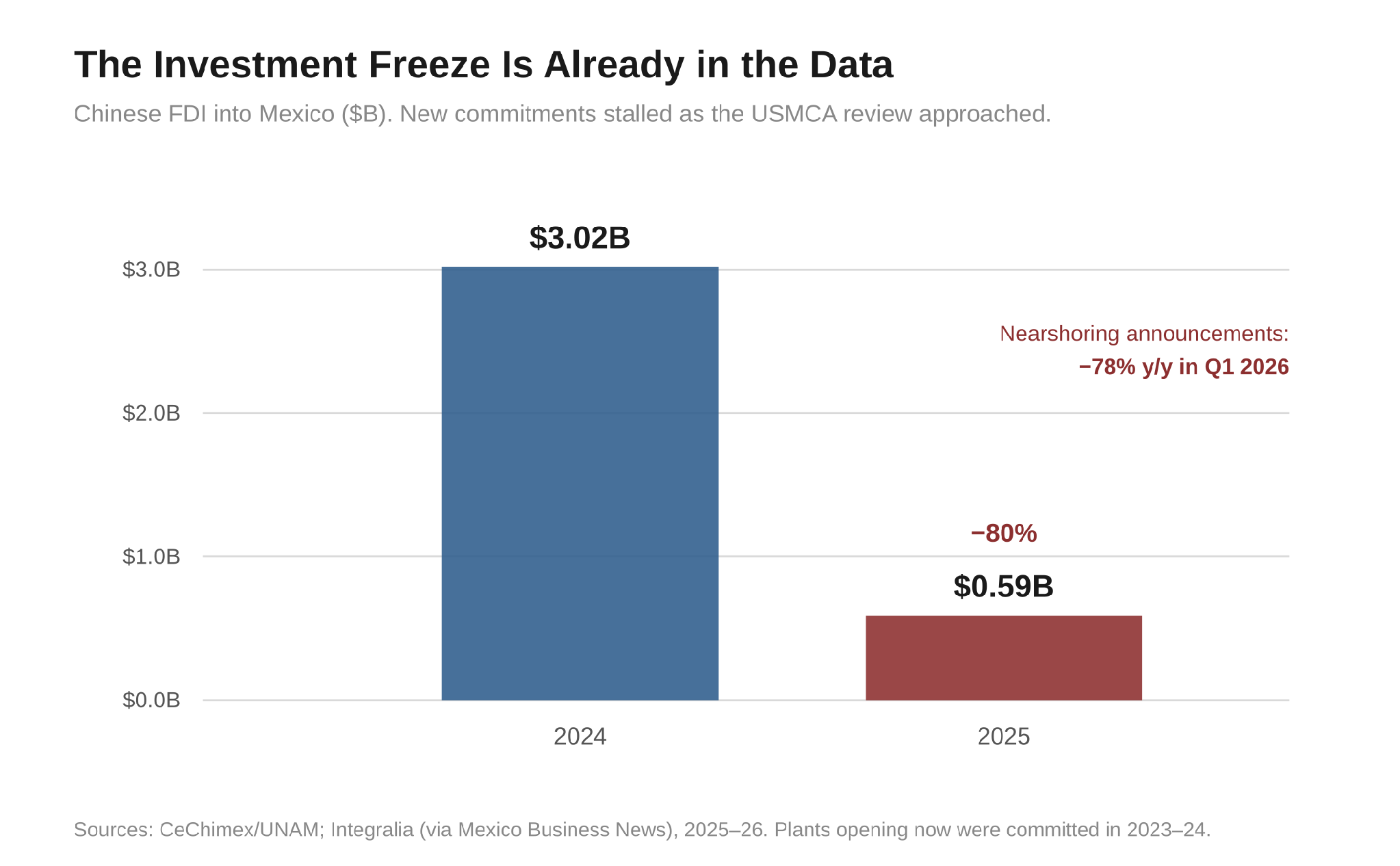
The interesting fact is that the freeze is already in the data. Chinese FDI into Mexico fell about 80% in 2025, to $588 million from roughly $3 billion, as the review approached.
Nearshoring investment announcements (a dubious metric, to be honest) dropped 78% year over year in early 2026. The plants opening now are the ones committed in 2023 and 2024, before the countdown started. New commitments have stalled, exactly as real options predict, exactly where the macro data can already see it.
.
How Do You Optimize Against a Countdown?
The hardest problem is the countdown itself, and it is where “ten years is generous” falls apart.
A cliff is one dated event.
You can model it, hedge it, build inventory into it, run it down on the far side. Washington built something else: a decade in which the terms of North American trade are reopened and renegotiated every year. In control-theory terms, the policy is non-stationary. The distribution you are optimizing against moves under you each year for 10 years. Every operations person knows the theorem in their gut, even if they never wrote it down. You cannot optimize a point forecast against a moving target. Tune your network to the 2027 rule, but if it is mistuned for 2028, retuning is not free.
Baker, Bloom, and Davis built the standard measure of this, the Economic Policy Uncertainty index, in the Quarterly Journal of Economics in 2016. Their result is the one that bites here: policy uncertainty depresses investment and hiring on its own, independent of its level.
Firms are not forecasting bad rules.
They cannot tell which rules, so they wait.
When an investment is irreversible, and the future is uncertain, waiting has value, and that value rises with uncertainty. A plant is about as irreversible as money gets. So the rational response to ten years of annual renegotiation is to defer the plant, and it is already happening: through 2025, roughly 45% of executives said they would cut capital spending, and 40% said they would slow hiring, with investment running about 4.4% below trend on uncertainty alone. Penn Wharton’s Budget Model, down the hall from me, estimates the long-run GDP hit from the tariff structure at near 6%.
Here is the trap.
The countdown was supposed to buy time.
Real options says it does the opposite.
A decade of resolvable yet unresolved uncertainty freezes investment needed to adjust to the new regime. The firm that most needs to build a US plant before 2036 is the same firm that, facing ten years of annual renegotiation, has every reason to wait one more year. Then one more. The option to wait is most worth it exactly when you can least afford to use it. That is not a runway. It is a decade-long incentive to stand still, bolted to a deadline that demands you move.
So what do you do?
The reflex when the rules get messy is to rerun the sourcing model on the new schedule and re-optimize for the cheapest, compliant network. But this is the wrong approach. You are optimizing a point forecast against a moving target, and it builds a network that is brittle in the one dimension that matters.
The better strategy is a tailored base-surge aimed at policy risk rather than demand risk: keep the cheap base, and pay to keep a responsive surge available and certain, because that availability is the asset.
Dual-qualify across a border that you are not sure will stay open. Hold buffer against the crossing you cannot predict.
The issue is that these strategies read as inefficiencies in a spreadsheet designed for a stable world, which makes little sense in the short term.
Will It Even Die?
Not cleanly, and maybe not at all.
The sunset is reversible at every one of the ten annual reviews. The deal was already renegotiated once, in 2018, and survived. It cleared the US Senate 89 to 10 in January 2020, one of the most bipartisan trade votes in a generation. Mexico is now the single largest US trading partner. The auto lobby, the farm lobby, and every governor with an assembly plant will fight to keep it. If you had to put a number on it, a renewal before 2036 is at least a coin flip, and probably better.
None of that saves you.
A 60% chance of renewal is not a renewal.
The investment freeze does not require an exit. It only needs the exit to be impossible to rule out.
Real options do not price the mean outcome. They price the distribution’s width, and this is enormous, remaining so for 10 years, no matter which way the early reviews lean.
That is the whole trap in one line: The most likely single outcome is that USMCA survives, and the countdown still does its damage, because the damage was never the exit.
It was the decade of not knowing.
The Final word
Tell me what constrains you, and I will tell you where your strategy should focus.
For thirty years, the constraint was cost, and the answer was efficiency.
The constraint just changed.
It is now the variance of the rules themselves, and no amount of efficiency buys you out of that.
The firms that come through the next decade in one piece will not be the ones with the lowest landed cost in 2027. They will be the ones who worked out how much inefficiency to carry, and where to put it, so that when the 2031 review breaks the wrong way, they can still move.
The countdown started on June 30. Everyone is watching the wrong clock.
The border did not close.
The certainty did.
I agree with your conclusion but think the macro warrants of this piece are a bit weaker than they were presented. Specifically, I think two-way trade in nominal dollars is a bit deceptive:
1. All else equal, it will scale roughly in line with the nominal GDP growth of both countries
2. Secularly, supply chains have become more integrated over borders over the horizon displayed in the chart (so plotting the US with any country, including one not systemically important in our supply chain, would show this trend)
3. I believe the Dallas Fed numbers include the commodity import/export, important because Mexico depends on US refiners to process their crude. That part of the trade surplus / deficit is pretty structurally disconnected from the focus of NAFTA/USMCA
Looking at the GTIS numbers, the conclusions still hold in a weaker form; Mexico was about 10% of the non-commodity total imports and total exports in 1993 and is about 16% / 17% today respectively, nothing to scoff at but a far cry from China which went from 8% to 25% down to 17%. Markets are penciling in a roughly 49% chance it is extended within 2026; the peso and Mexican sovereign spreads are both sanguine; I'd put it as 75% it's extended within a calendar year. Directionally I feel your conclusions are correct but don't think this is the scariest supply chain story out there