Why Did Allbirds Fail?


Last week, Allbirds announced it had signed a definitive agreement to sell all of its assets and intellectual property to American Exchange Group for $39 million.
The company that had raised $303 million in its November 2021 IPO surged to a $4.1 billion valuation on its first day of trading and was the unofficial shoe of Silicon Valley and the poster child of sustainable consumer brands. That company was selling for roughly a penny on the dollar.
I want to sit with that number for a moment. Thirty-nine million dollars.
That is less than what Allbirds spent on marketing in a single year. It is less than the company lost in any given quarter during its post-IPO decline. It is roughly one-tenth of the capital invested by the company’s investors when it went public. The stock, which had closed at $28.64 on its first day of trading, was trading at $2.98 the day before the sale was announced, and the $39 million represented a premium to where the market had already priced the company. The market, in other words, had already decided that Allbirds was worth less than what a buyer was willing to pay for its scraps.
How did this happen?
How does a brand that was genuinely loved by a loyal customer base end up dissolving itself five years after going public?
The conventional narrative is that Allbirds was a pandemic darling that couldn’t survive normalization. There is truth in that. But it is not sufficient. Hoka and On Running were also riding tailwinds during the same period, and they have not only survived but thrived.
The footwear category did not collapse.
Allbirds did.
I want to analyze Allbirds through the SCALE framework. The framework resists the temptation to evaluate any single dimension in isolation. Every strategic decision is simultaneously operational, financial, cultural, and competitive.
Allbirds is, in many ways, a case study in how these dimensions can unravel together, how weakness in one area compounds into weakness in every other.
S: Scalable: The Product That Couldn’t Expand
Allbirds was founded in 2015 by Tim Brown, a former New Zealand soccer player, and Joey Zwillinger, a renewable energy engineer and Wharton alumnus. Brown had a simple insight: merino wool, which New Zealanders knew as an extraordinary textile, was not being used in footwear. He and Zwillinger launched a Kickstarter campaign in 2014 that hit its $30,000 goal in five days and ultimately raised nearly $120,000. They officially launched Allbirds in 2016.
The Wool Runner, a minimalist, comfortable, machine-washable sneaker made from natural materials, became a sensation. It was the shoe you saw in every VC meeting, every co-working space, every airport lounge in San Francisco and New York.
I remember the first time I met Joey in SF, he was kind enough to give another faculty member a pair and me. This was the first time I heard about the brand. When I boarded the flight back to Philly, half the plane wore these shoes.
The initial product-market fit was extraordinary.
Allbirds had identified a genuine gap: a shoe that was comfortable, aesthetically understated, and carried an environmental story that its target demographic cared about. For a brief window, owning Allbirds was a signal of belonging to a certain kind of professional class.
But scalability requires more than a great first product. It requires the ability to expand the addressable market through new products, customer segments, occasions, and geographies, without diluting the core value proposition. And this is where the numbers tell a devastating story.
Start with revenue growth. In 2020, Allbirds generated $219 million in net revenue, growing to $277.5 million in 2021 (a 27% increase) and $297.8 million in 2022 (a 7% increase). That deceleration from 27% to 7% is the first signal. The core product was saturating its addressable market, and the extensions were not generating enough incremental demand to sustain the growth rate. By 2023, revenue had fallen to $254.1 million, a 14.7% decline. By 2024, it was $189.8 million, down another 25.3%. The 2025 guidance of $161 to $166 million implied a further decline of roughly 14%.
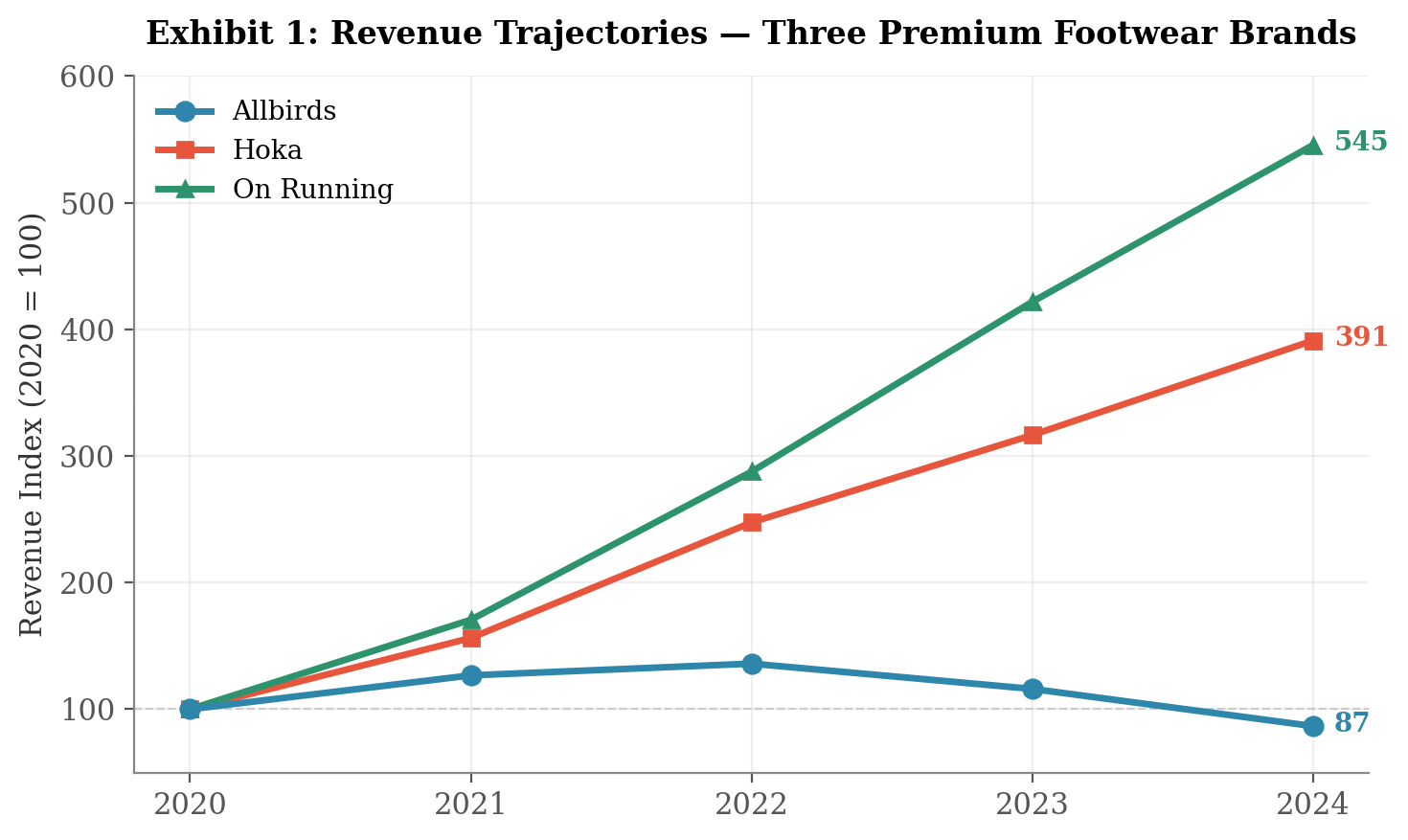
To put this in perspective, consider what Allbirds’ two closest competitors were doing over the same period. Hoka, which had been a niche trail-running brand when Allbirds launched, grew from $892 million in fiscal 2022 to $1.41 billion in fiscal 2023, $1.81 billion in fiscal 2024, and $2.23 billion in fiscal 2025, compounding at roughly 36% annually.
On Running grew from CHF 1.22 billion in 2022 to CHF 1.79 billion in 2023 to CHF 2.32 billion in 2024, compounding at roughly 38%. Both companies were scaling through the same macroeconomic environment.
The footwear market was not shrinking.
Allbirds was.
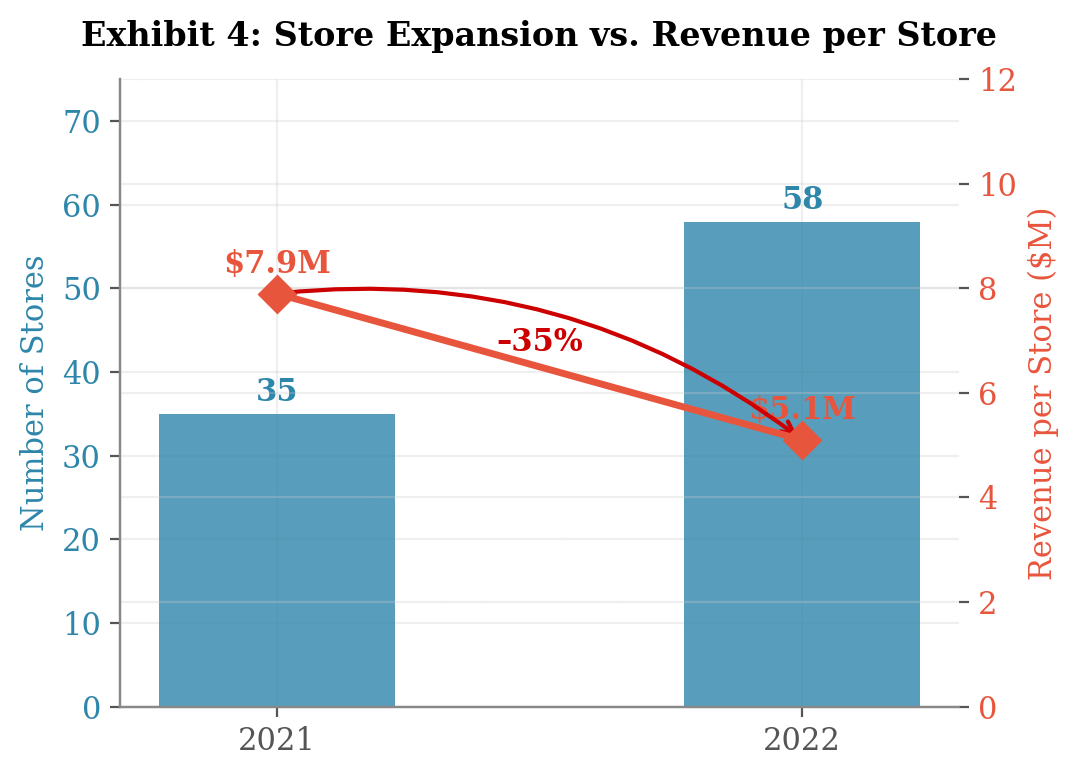
The divergence is even starker when you look at the physical retail buildout. Allbirds opened 13 stores in 2021, bringing its total to 35. It then opened 23 more in 2022, bringing the total to 58, 42 in the United States and 16 internationally.
Each store required lease commitments, buildout capital, staffing, and inventory.
In 2021, with 35 stores and $277.5 million in revenue, the implied revenue per store was approximately $7.9 million. By the end of 2022, with 58 stores and $297.8 million in revenue, that figure had dropped to roughly $5.1 million. Revenue per store fell 35 percent in a single year.
The stores were cannibalizing digital sales rather than creating new demand. By January 2026, every full-price store in the United States was closed.
.
The product expansion strategy was the main issue.
Allbirds tried to extend beyond the Wool Runner into tree-fiber shoes, performance running shoes, and apparel, including $250 puffer jackets and $88 dresses that had to be marked down almost immediately.
The running shoe was a particularly expensive misfire. The Tree Dasher, launched in 2020, and the Tree Flyer, released in 2022, entered a segment dominated by Nike, Adidas, New Balance, Hoka, and On Running, companies with decades of biomechanical R&D, professional athlete endorsements, and distribution infrastructure.
Allbirds brought a sustainability story to a category where performance is the price of entry. By the time leadership acknowledged the overextension, the company was planning to cut its SKU count by 25 to 40 percent, essentially admitting that half the product line should never have existed.
This raises a deeper strategic question: why attempt to penetrate the hyper-competitive performance running moat at all? Rather than fighting entrenched giants on biomechanical turf, Allbirds could have explored defensible expansions within casual, comfort-first categories, such as premium house slippers, recovery wear, or elevated casual loafers, where their core proposition of soft comfort and sustainability held natural authority.
The root cause of the scalability failure is that the product was not a platform. It was a single (admittedly brilliant) idea that did not naturally extend into adjacent categories.
Contrast this with On Running, which built a proprietary cushioning technology, its CloudTec sole, that could be deployed across trail, road, training, and lifestyle segments, each with clear performance claims. Or Hoka, which was built around a maximalist cushioning thesis that first appealed to ultrarunners and then expanded to hikers, walkers, and eventually everyday consumers.
Both companies had product architectures that could scale. Allbirds had a material story, wool, trees, sugarcane, that was appealing but did not translate into a defensible competitive advantage across categories. And the revenue trajectories show exactly what that difference costs.
C: Constrainable: The Durability Problem Nobody Wanted to Talk About
Every company faces constraints. The question, in the SCALE framework, is not whether constraints exist but whether leadership is aware of them and has the capacity to manage within them.
Allbirds had a constraint that was both fundamental and, for a long time, largely unacknowledged: its shoes fell apart.
I am not being hyperbolic.
Review after review, across Trustpilot, Reddit, and product review sites, tells the same story: the wool upper pills and thins. The sole, made with Allbirds’ proprietary sugarcane-based SweetFoam, wears down significantly faster than conventional rubber outsoles, measured at roughly 23% softer than average shoes with rubber outsoles. The structural bond between the upper and sole fails. Multiple customers reported that shoes became unwearable within 6 to 12 months of regular use, even with only office and casual wear.
This is where the sustainability story, Allbirds’ most powerful marketing asset, became its most dangerous operational constraint. The company had built its brand around natural materials and low carbon footprints. But the materials that reduced environmental impact also reduced durability. Wool is more delicate than synthetic mesh. SweetFoam is softer and less abrasion-resistant than petroleum-based rubber. The company was, in effect, asking customers to pay a premium ($98 to $135 for a pair of Wool Runners) for shoes that would last roughly half as long as comparably priced competitors.
This is a non-trivial constraint. It is not a supply chain problem you can engineer around, or a tariff you can mitigate through sourcing diversification. It goes to the heart of the value proposition. If your brand promise is sustainability, and your product’s short lifespan means customers are buying twice as many shoes, you have a sustainability problem you cannot market your way out of. The math does not work; not for the customer’s wallet, and not for the planet.
A company with strong constraintability would have confronted this trade-off directly. It would have invested heavily in materials science to close the durability gap, been transparent with customers about expected product life and priced accordingly, or launched a repair-and-refurbishment program that turned the short lifespan into a circular-economy story.
Allbirds did none of these things with sufficient urgency. The durability complaints accumulated. Repeat purchase rates declined. And the customers who had been Allbirds’ most enthusiastic ambassadors became its most vocal critics.
A: Aligned: A Brand That Lost Its Customer
Alignment asks whether a company’s strategy is coherent across its customer base, its operational model, and the broader competitive environment. By 2022, Allbirds was misaligned on all three.
Start with the customer. Allbirds’ original audience was affluent, urban, professionally employed, and environmentally conscious. These customers did not need to be sold on sustainability. They were already there. What they needed was a product that worked: comfortable, good-looking, appropriate for casual professional settings.
The Wool Runner delivered that. But as the product expanded and quality complaints grew, the core customer drifted. Hoka and On Running, both of which had been building momentum through the same period, offered shoes that were comfortable, stylish in an understated way (at least with On), and, crucially, durable. By 2023, the same demographic that had once reached for Allbirds was reaching for On Running’s Roger Advantage or Hoka’s Bondi.
Furthermore, this drift was not purely operational; it was cultural. Allbirds initially succeeded because its shoes were an exclusive ‘in-group’ signal for the Silicon Valley elite. As the brand expanded its physical retail footprint and became ubiquitous, it lost its scarcity and cachet. In the apparel sector, widespread availability often destroys a brand’s ‘cool factor’ long before product fatigue sets in.
Then there was the operational model. Allbirds had built itself as a direct-to-consumer brand: online sales supplemented by a growing fleet of company-owned retail stores. After the IPO, the company accelerated its physical retail expansion, growing from 27 stores in mid-2021 to 58 stores by the end of 2022. But the economics of physical retail for a DTC brand are brutal. Each store requires lease commitments, staffing, buildout capital, and inventory, fixed costs that only make sense if foot traffic and conversion rates are high enough to justify them. As brand momentum slowed, those stores became liabilities. Revenue per store declined. The fixed cost base remained.
In January 2026, Allbirds announced it would close all full-price stores in the United States by the end of February, retaining only four locations globally. The entire retail strategy, the 58-store network that was supposed to be the growth engine, was unwound in less than four years. That was an admission that the bet was wrong, probably from the beginning.
And finally, the competitive environment. Allbirds entered the footwear market at a moment when sustainability was a powerful differentiator. By 2023, it was table stakes. Nike launched its Move to Zero sustainability platform. Adidas partnered with Parley for the Ocean, and on Running developed its fully recyclable Cyclon shoe subscription.
The sustainability “moat” that Allbirds had carved was no longer unique, and the companies filling it in had vastly more resources, broader product ranges, and stronger performance credentials.
L: Led Well: The Leadership Question
Allbirds was co-led by Tim Brown and Joey Zwillinger from its founding through March 2024, when Zwillinger stepped down as co-CEO. Brown remained as the sole CEO, and in 2024, Joe Vernachio was brought in as CEO to lead a turnaround effort. The co-CEO structure, while not inherently problematic, reflected a broader tension in the company’s identity.
Brown was the brand and design visionary. Zwillinger was the operations and sustainability engineer. Together, they built an extraordinary startup. One should not let the sales price dictate what we think of Allbirds as a venture.
But the skills required to scale a public company through competitive headwinds and margin pressures differ from those needed to launch a Kickstarter campaign and build a cult brand.
The post-IPO period required a set of difficult decisions that, by most external evidence, were either made too late or not made at all. The decision was made to accelerate store openings as revenue growth decelerated.
The decision to expand the product line into categories where Allbirds had no competitive advantage.
The decision to maintain premium pricing while the durability problem eroded the price-value equation.
The decision was made to maintain the course on sustainability-first materials science while customers moved to more durable alternatives.
These are not obvious mistakes in isolation. Each one could be defended on its own terms.
But taken together, they reveal a leadership team that was optimizing for the brand it wanted to be rather than the business it needed to become. There is a version of Allbirds that, after the IPO, slowed its store expansion, doubled down on materials science to fix the durability problem, narrowed its product focus back to its core silhouettes, and built a business that was smaller but sustainable, in the financial sense.
That version would have required the founders to accept that Allbirds would not become a multi-billion-dollar lifestyle brand. It would have required the discipline to say no to the growth story that the IPO valuation demanded.
This is the fundamental tension facing every DTC brand that goes public. The capital markets want growth. Growth requires expansion: more stores, more products, more geographies. But expansion, if it outpaces the brand’s core competence and product quality, destroys what made the brand valuable in the first place. Allbirds’ leadership navigated this tension by choosing growth, and the growth consumed the brand.
However, blaming leadership for choosing growth ignores the brutal mechanics of the capital markets.
Once a company takes on venture capital, goes public, and achieves a multi-billion dollar valuation, leadership has a fiduciary duty to its shareholders to pursue massive scale. The idea of intentionally remaining a smaller, sustainable niche brand is a luxury afforded to private, bootstrapped companies, not a viable option for a heavily funded unicorn.
E: Efficient: A Path to Profitability That Never Materialized
I want to walk through the full P&L trajectory, because the numbers tell a story that no narrative summary can fully capture.
Start with the top line. Revenue grew from $219 million in 2020 to $277.5 million in 2021 to $297.8 million in 2022, and then reversed, falling to $254.1 million in 2023 and $189.8 million in 2024.
Growth decelerated from 27% to 7%, then to negative 15%, and then to negative 25% over four consecutive years.
By 2025, the company was guiding to $161 to $166 million, representing a 44% decline from the 2022 peak. This is a business in structural decline.
Now look at gross margin, which is where the operational damage becomes visible.
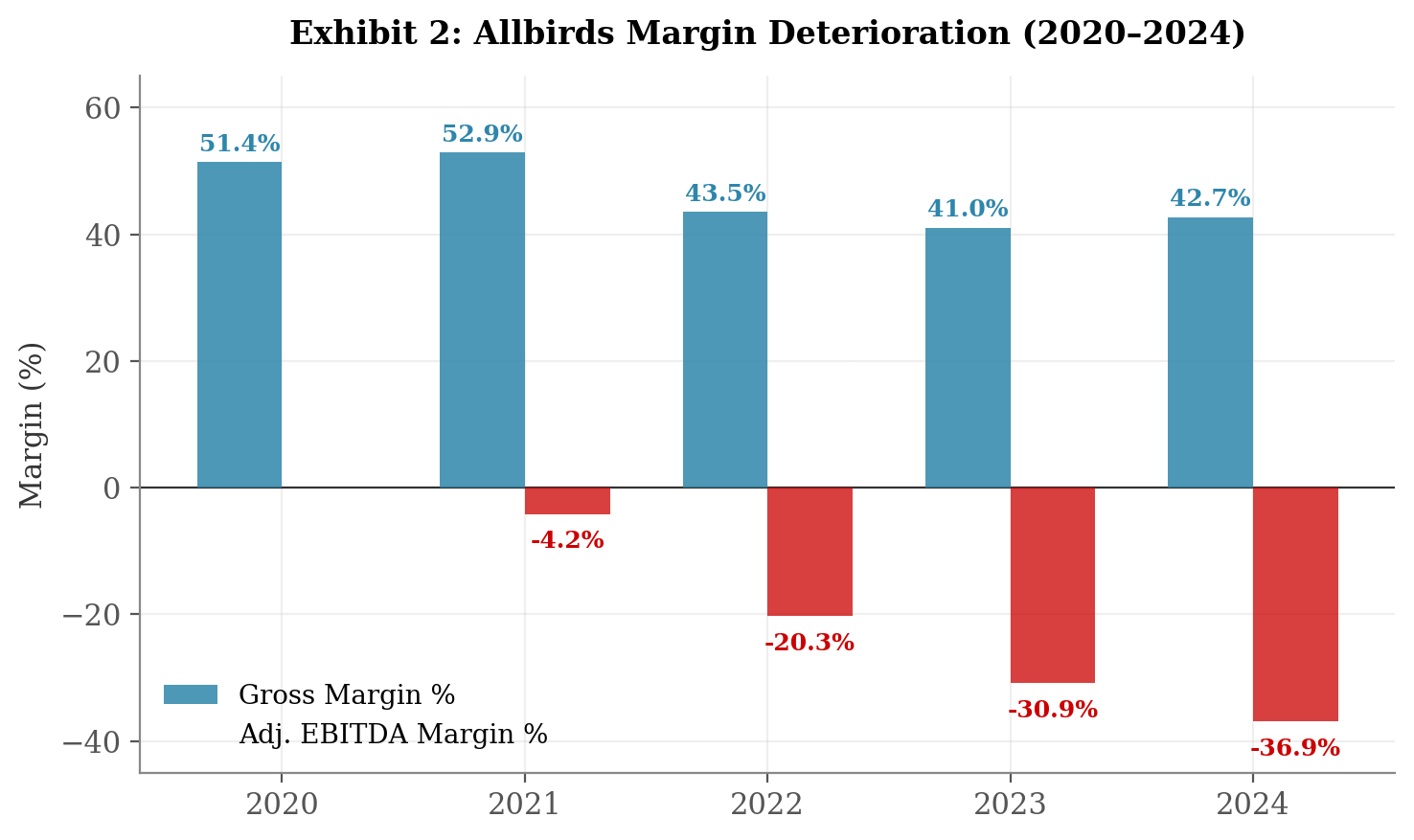
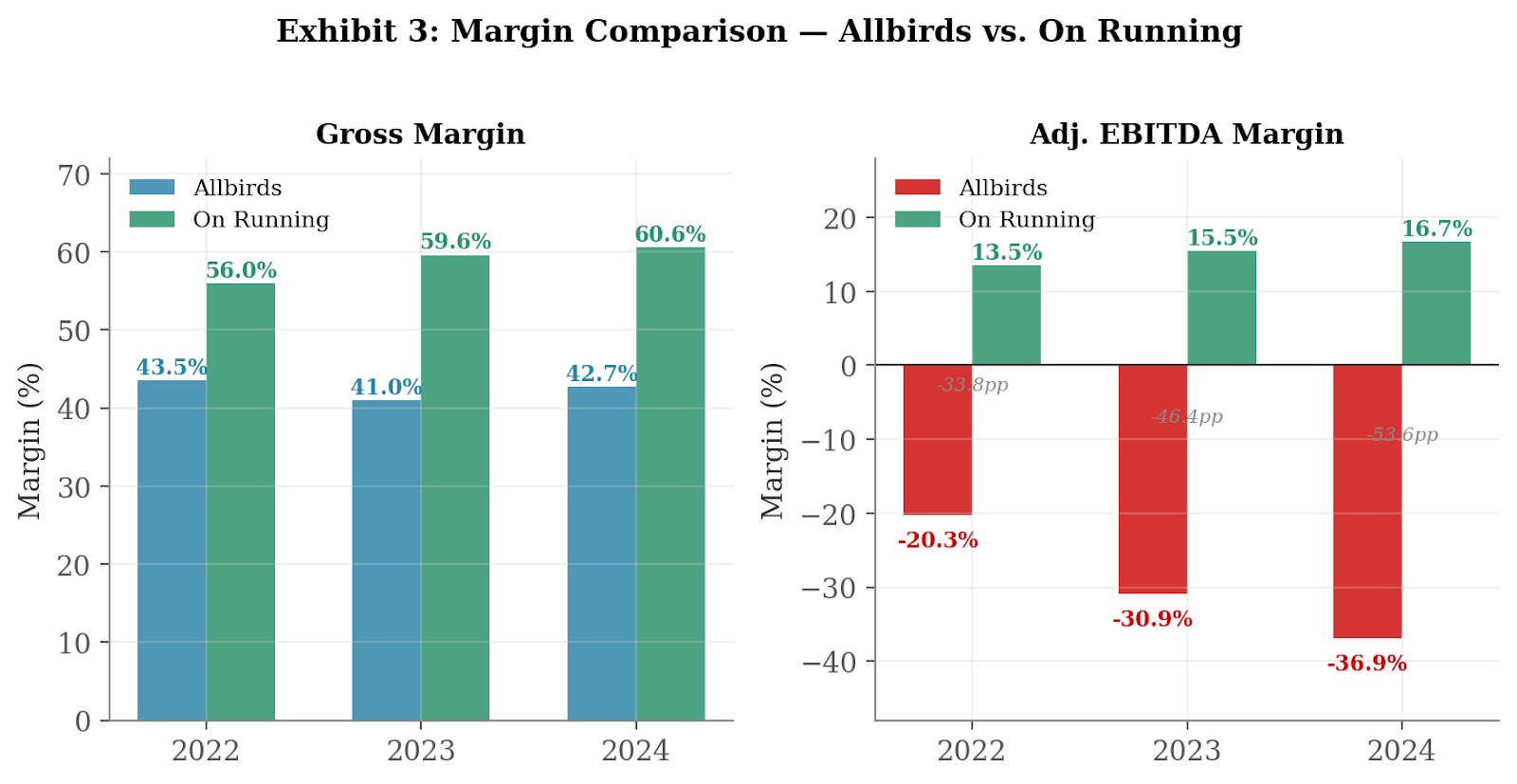
In 2020, gross margin was 51.4%. In 2021, it improved slightly to 52.9 percent — $146.7 million on $277.5 million in revenue. Then the floor dropped. Gross margin fell to 43.5% in 2022 ($129.6 million in gross profit on $297.8 million in revenue), to 41.0% in 2023 ($104.2 million), and to 42.7% in 2024 ($81.1 million). The gross margin compressed by more than ten percentage points from peak, and while the 2024 rate ticked up slightly, the absolute dollars collapsed from $146.7 million to $81.1 million, a 45% decline in gross profit.
The margin compression had two drivers.
First, the channel mix shifted. As Allbirds opened stores and began experimenting with third-party wholesale, the proportion of high-margin direct digital sales, which incur no physical overhead and no wholesale discount, declined relative to lower-margin channels.
Second, discounting intensified. With brand momentum fading and inventory building, the company was forced to move product at reduced prices, eroding the full-price sell-through that is the lifeblood of any premium brand.
But gross margin was only half the problem. The real issue was the operating cost structure. SG&A expenses ran at $166.7 million in 2022, or 56.0 percent of revenue.
In 2023, despite a $43.7 million revenue decline, SG&A fell to $174.0 million, an actual $7 million increase in absolute terms, pushing the SG&A ratio to 68.5% of revenue. By 2024, management had cut SG&A to $133.4 million, but with revenue falling even faster, the ratio worsened to 70.3%.
When your SG&A alone consumes 70% of revenue, and your gross margin is 43%, you are losing roughly 27 cents on every dollar of sales before you account for anything else. No version of that math works.
Marketing spend tells a related story of diminishing returns. In 2022, Allbirds spent approximately $59 million on marketing, or 19.9% of revenue. In 2023, it cut marketing spending to $49 million, which was still 19.3% of revenue. In 2024, it cut further to $41.6 million, but that now represented 21.9% of a much smaller revenue base.
The company was spending less in absolute terms but more as a share of every dollar it earned, and getting progressively less for it.
The adjusted EBITDA line captures the full trajectory of this deterioration. In 2021, the adjusted EBITDA margin was negative 4.2 percent, a loss of $11.7 million that could plausibly be described as an investment in growth. By 2024, the margin had further deteriorated to negative 36%, resulting in a $70.0 million loss on a shrinking revenue base. Every year, the business consumed more cash relative to its size than the year before. The losses were not converging toward zero. They were accelerating away from it.
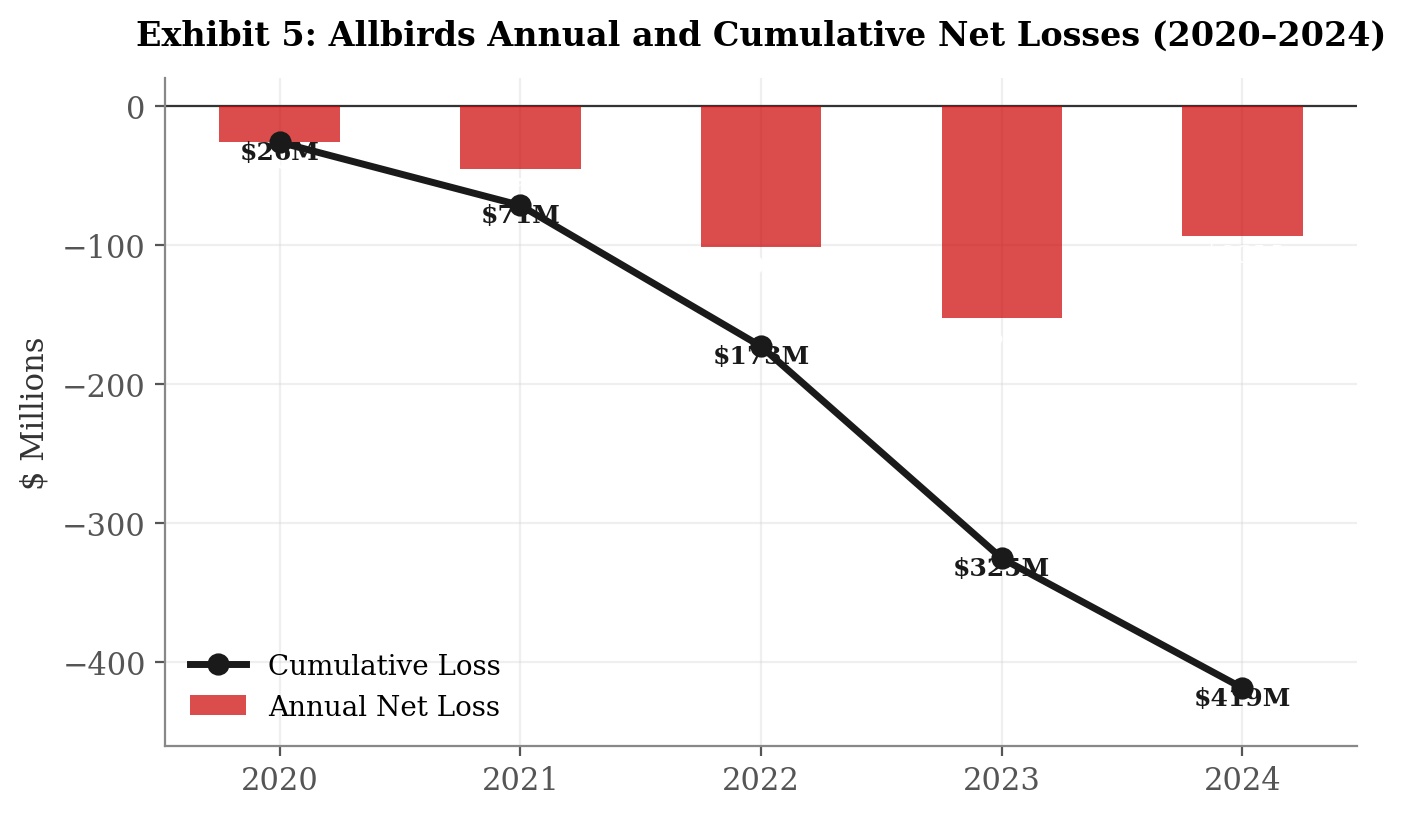
The cumulative damage is staggering. Over the five fiscal years ending in December 2024, Allbirds lost $419 million on $1.24 billion in total sales, a blended net loss margin of approximately 34%. The net loss was $45.4 million in 2021, $101.4 million in 2022, $152.5 million in 2023, and $93.3 million in 2024. The narrowing in 2024 was driven entirely by cost cuts, store closures, headcount reductions, and marketing pullbacks — rather than improved fundamentals. Revenue continued to decline even as expenses were slashed.
The comparison with On Running is interesting, and frankly, painful. In 2022, On Running posted gross margins of 56.0 percent and adjusted EBITDA margins of 13.5 percent. In 2023, those improved to 59.6 percent and 15.5 percent. In 2024, 60.6 percent and 16.7 percent. On Running’s gross margin was 15 to 18 percentage points higher than Allbirds’ in every year, and its EBITDA margin was positive and expanding, while Allbirds’ was negative and worsening. Both companies sold premium footwear to affluent, style-conscious consumers. One had a cost structure that worked. The other did not.
.
There was no predictable path to profitability.
And this is what ultimately killed the company. A business can sustain losses if it can articulate, credibly, how those losses convert into future earnings. Amazon lost money for years but could point to growing revenue, expanding infrastructure, and network effects that would eventually generate margin.
Allbirds had declining revenue, rising SG&A as a percentage of that revenue, deteriorating EBITDA margins, a product with known quality issues, and a competitive position that was weakening quarter by quarter. The losses were not an investment in future profitability. They were the steady bleed of a business model that did not work at scale.
The Integrated SCALE Picture: What Allbirds Tells Us
The SCALE framework’s power lies in understanding how the five dimensions interact. Allbirds is a case study in negative compounding, where weakness in one dimension amplifies weakness in every other.
Scalability failed because the product did not extend beyond its original silhouette.
That scalability failure put pressure on the efficiency dimension, because the company could not grow revenue to cover its expanding cost base.
The constrainability problem, the durability trade-off inherent in sustainability-first materials, eroded alignment between the brand promise and the customer experience, accelerating customer defection and further damaging scalability.
Leadership, facing the gap between the company’s IPO valuation and its operational reality, chose to push forward on expansion rather than retreat to a defensible core, which deepened the efficiency problem. Each dimension pulled the others down.
Contrast this with a company like On Running, which scores well across all five dimensions. Its CloudTec technology scales across categories. Its constraints, primarily competition from larger incumbents, are managed through focused innovation and strategic retail partnerships. Its alignment between performance credibility and lifestyle aspiration is tight. Its leadership has maintained discipline on margin and growth pace. And its path to profitability is clear, with the company having already achieved positive operating income. On Running is what Allbirds could have looked like if the strategic choices had been different.
The Deeper Lesson
The $39 million sale to American Exchange Group is a sobering conclusion. American Exchange is a wholesale footwear and accessories company, exactly the kind of mid-market distributor that DTC brands were supposed to make obsolete. There is a certain irony in the fact that Allbirds, which raised hundreds of millions on the premise that it could bypass traditional retail, is ending up as intellectual property in the portfolio of a traditional middleman.
I do not know what American Exchange will do with the Allbirds brand. They may license it to mass-market retailers. They may likely produce cheaper versions of the Wool Runner at scale. The name may appear on a shelf at Costco someday, which would represent a final, complete inversion of everything the brand once stood for.
What I do know is that Allbirds, at its peak, had something genuine. It had a product people loved, a story people believed in, and a customer base that wanted the company to succeed. That is more than most startups ever achieve. The failure was not in the founding vision. It was in the execution that followed, the choices made under the pressure of public market expectations, the constraints left unaddressed, the misalignment between what the brand promised and what the product delivered.
Allbirds started as one of the most interesting companies in consumer retail. It ended as one of the most instructive. The difference between those two things is about $4 billion.
Riveting post. Thank you. Remembering the early days where those shoes were indeed (annoyingly) ubiquitous at venture events out here.
It's a great analysis, but there's one thing we should keep in mind
Companies don't need a reason to fail, failure is the default .
All companies are destined to fail, unless they miraculously stay alive.
It's not that they did lots of incorrect things, it's that they didn't do much right
They basically had a single sneaker go viral, and people mistook one shoe SKU for a technology company.